Reviewed 9 September 2026. Calculations and operating choices are separated from manufacturer specifications.
| Source | Used for | Does not establish |
|---|---|---|
| INFWIN MT22 product page and manual v6.01 | SDI-12 raw/temperature/EC mapping; generic soilless and mineral conversion; raw range; EC already normalised to 25°C | A validated rockwool-Prestige or coco-specific calibration, or actual pore-water EC |
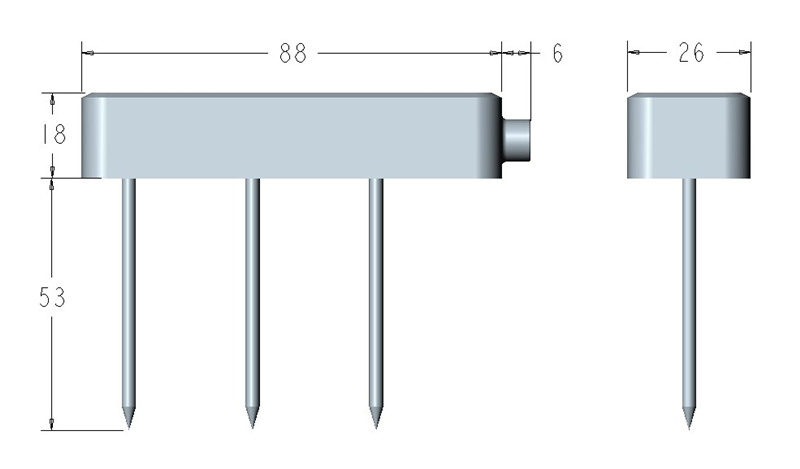
| INFWIN dimension drawing | 88 × 26 mm contact face, 18 mm housing depth, 53 mm rods | Pin pitch, exact electromagnetic footprint in each medium, best Prestige location |
| Grodan Precision Irrigation guide, especially pp. 4–6 | Stacked growing volumes, block and 90 cm slab dimensions | A universal target for an independently calibrated MT22, or the dimensions of every 1 m Prestige SKU |
| Grodan Prestige | Product context | User's exact slab width and height |
| GroSens sensor placement instructions | Importance of reproducible positioning and depth | An interchangeable MT22 bracket or placement specification |
| METER electrical conductivity guide | Distinction between bulk and pore EC, substrate dependence of conversion | That bulk EC divided by VWC is a validated salt mass-balance model |
| METER TEROS 11/12 manual | Independent measurement-method background | Same accuracy, electronics or calibration merely because another sensor uses a compatible protocol |
| CANNA compressed coco product | Hydrated growing volume versus compressed shipping volume | Actual fill volume of a particular user's pot |
| ESPHome template numbers, globals, sensor filters | Runtime inputs, persistent calibration and timeouts | Probe calibration accuracy |
The 100-count / 10-percentage-point A/B separation, central-80% C placement, 3-point default check tolerance, ten-sample stability window and midpoint placement guides are project acceptance/design choices. They are not INFWIN or Grodan guarantees. A third-point check only tests that observation under those conditions; it does not certify the whole curve, every location, temperature or EC range.
This project does not present crop steering as a guaranteed increase in flower yield or potency. Reliable measurements, representative placement and actual irrigation delivery come before crop-specific trials.