Integrated pest management blueprint for indoor medicinal cannabis in Auckland
HomePlant healthIntegrated pest management blueprint for indoor medicinal cannabis in Auckland
Plant health · Auckland medicinal cannabis

Integrated pest management blueprint for indoor medicinal cannabis in Auckland

An exclusion-first, residue-aware operating system for clean stock, pest and disease identification, lawful control selection, crop-cycle monitoring, CAPA, batch hold and release.

Plant health23 generated photo platesOfficial NZ + primary sources~55 min read
01 · Read this first

What this blueprint is, and what it refuses to pretend

This is an operating blueprint for an indoor medicinal-cannabis facility in Auckland. It joins pest and disease identification to clean stock, New Zealand input legality, worker safety, residue release, traceability and CAPA. The point is not to own the most sprays. The point is to keep biology and compliance from cornering you at the same time.

The supplied 128-page IPM Book V15 was used as a coverage benchmark: IPM principles, cultural/environmental/biological/chemical controls, programme construction, eight arthropod profiles, six disease profiles, identification resources, glossary and operator tools[10]. Its branded programmes, artwork, rates and prose are not reproduced. New Zealand official sources and primary literature control this paper.

Generated photographs are educational reconstructions

Every photographic plate in this guide was generated for the paper. Use it to decide where to look and what to sample, never to claim species-level confirmation. Broad and russet mites require microscopy; HLVd requires RT-qPCR or RT-PCR; root and leaf diseases often require a diagnostic laboratory. A convincing image is not a test result.

  • Live status wins. Re-check the current Ministry, ACVM, EPA, label, SDS and WorkSafe position at procurement and use.
  • Facility thresholds are controlled values. Numbers in this blueprint are examples or planning defaults unless your approved SOP adopts them.
  • Old damage does not heal. Verify success with live organisms, new lesions, new growth, traps, roots or laboratory results - not cosmetic recovery.
  • Clean stock is the centre. A mother-room failure compounds through every daughter lot. Treat it accordingly.
Evidence to action1Observemapped scout,trap,environment ortest2Confirmmicroscopy orlaboratory whererequired3Classifyroom, incidence,severity, trend,zero-tolerance4Selectlegal +effective +compatible +residue-defensible5Verifyrecheck, record,close or CAPA
Figure 1. The control path. Skipping confirmation or the legal gate is how a small biological problem becomes a batch problem.
How sure is this?

Accuracy, self-review, and grain-of-salt notes

How sure is this paper?

We've gone to great lengths to keep these guides honest. One of the main ways we do that is self-review: we actively look for claims that are subjective, only lightly backed by literature, or based on grower practice rather than a controlled study — and we call those out instead of dressing them up as settled science.

Often there simply is no paper for the decision you're making. In those cases we're drawing on what other growers report and what has worked in our own rooms. That can still be useful — but it is not a lab proof. Do what works for your plants, your room, and your meters. If a table disagrees with your crop, believe the crop and log the difference.

Solid
Well supported by plant science, standards, or broad multi-source consensus
  • Exclusion, clean stock, monitoring, and CAPA structure
  • NZ pathway thinking: approval/status is not the same as 'someone used it once'
Operational
What many growers and rooms actually run — start here, then tune
  • Threshold models and mother-room controls as facility SOPs
Grain of salt
Subjective, thin literature, single studies, or “this works for us” practice
  • Any named product/organism status without checking the live register today
  • AI-generated diagnostic plates as confirmatory ID (training aids only)

See something glaringly wrong? Tell us and we'll fix it. Please open a GitHub issue with the paper name and what looks off (include a source if you have one): Report an accuracy issue. Local law, labels, and licences always override any recipe here. Inline notes labelled grain of salt flag the highest-risk over-trust points in the text.

02 · System

Six principles, four layers, one closed loop

IPM is a loop: prevent entry, monitor consistently, identify correctly, compare the finding with a controlled threshold, combine compatible controls, then record and verify. If the recheck fails, the loop runs again at a higher response level. The arthropod review and the existing cannabis literature support layered indoor management rather than a single calendar product[11].

The IPM decision loop1Preventexclusion,sanitation,clean stock2Monitorfixed route,traps, roots,environment3Identifyorganism + lifestage + source4Thresholdrisk + incidence+ severity +trend5Control + verifylayer tactics,recheck, record
Figure 2. Every intervention returns to monitoring. Without the recheck, it is activity rather than control.
The control pyramid in operating form. Chemical and reduced-risk inputs sit last, not because they never work, but because they carry the narrowest legal and compatibility envelope.
LayerPurposeRule
CulturalExclude, quarantine, sanitise, control movement, remove reservoirs, scout and record.Build from this layer before moving upward
EnvironmentalRemove the temperature, moisture, airflow and root-zone conditions that favour the problem.Build from this layer before moving upward
BiologicalEstablish the right predator, parasitoid, nematode or antagonist before pest pressure outruns it.Build from this layer before moving upward
Chemical / reduced-riskUse only after the legal gate, targeted to the right life stage and followed by a defined recheck.Build from this layer before moving upward
Zero tolerance is not the same as eradication everywhere

HLVd in clean stock, broad/russet mites in quarantine, root aphids in propagation, powdery mildew on flowers and Botrytis inside a bud are exclusion or quality events. A low fungus-gnat adult count in an established vegetative room may be a trend-management problem. Use organism and room consequence, not one universal number.

A site severity scale. Incidence, trend and zero-tolerance overrides still apply.
SeverityNameDefinitionDefault response
0Not foundNo confirmed organism or damage. Continue the planned monitoring frequency.Monitor
1TraceOne confirmed individual, colony or lesion at one mapped site; no spread seen.Escalate by the approved decision matrix
2LocalMore than one finding in one zone, or a rising trap trend without room-wide spread.Escalate by the approved decision matrix
3EstablishedMultiple zones, repeated life stages, increasing disease incidence or biological control losing ground.Escalate by the approved decision matrix
4SystemicRoom-wide or linked-room spread, clean-stock involvement, crop-quality threat, or contaminated shared infrastructure.Escalate by the approved decision matrix
04 · Exclusion

Build the programme around clean stock, not rescue sprays

The mother room is not just where clones come from. It is a source-material system. Its failures multiply through every cutting, room and batch downstream.

HLVd can be asymptomatic, moves efficiently with vegetative propagation and contaminated tools, and research supports transmission risk through roots and recirculating hydroponic solution[24][25][26]. Visual health is therefore not a release test.

Genetics admission1Receiveapproved source+ accession ID2Quarantineseparateair/water/tools/staffflow3Inspect + traparthropods,roots, symptoms4Molecular indexvalidated HLVdmethod andtissue5Promote or destroytrace treebegins beforerelease
Figure 3. No genetics bypass quarantine, and no accession is promoted on appearance alone.
  • Foundation mothers are created only from released material and retain the cleanest controls.
  • Production mothers, cutting lots and rooms inherit a traceable parent-child relationship.
  • Tools are sanitised between defined plant units, not merely at the end of the shift.
  • Quarantine, foundation stock and production stock do not share nutrient solution or unvalidated return water.
  • A positive or inconclusive test has a written hold, repeat, destruction and traceback rule before the first sample is collected.
Planning cadence only. The controlled sampling plan must match the laboratory method, plant age, tissue, risk and facility history.
Plant classPlanning cadenceSampling ruleDecision rule
Incoming accessionAt entry and again before promotion where risk warrantsIndividual plant; validated tissue/methodNo promotion until release criteria are met
Foundation motherAt creation and risk-based recurring scheduleIndividual, no routine pooling unless validatedPositive = destroy, hold linked daughters, investigate
Production motherBefore major cutting campaigns or site-defined recurring scheduleIndividual or validated pool with reflex testingPositive = stop clone movement and trace since last verified negative
Clone lotRisk-based verification linked to mother statusLot-based plan with controlsHold linked rooms when source status is compromised
Hydro environmentInvestigation / sentinel use where system risk existsTank, return, root interface under validated methodPositive environmental signal triggers cohort investigation, not automatic plant diagnosis
A monthly test is not protection if the genealogy is broken

If you cannot identify every daughter lot since the last verified negative, a positive mother turns into a building-wide guessing exercise. Build the trace tree first.

05 · Contamination pathways

Control people, tools, air, water and waste as one system

Pests and pathogens do not care which department owns a vector. A clean-stock programme fails if workers backtrack, scissors cross mothers, return air connects quarantine, or a shared reservoir moves root pathogens. Cannabis disease reviews repeatedly identify stock, tools, water, debris, density and environmental conditions as interacting routes[19].

One-way hygiene gradient1Clean supportstores, cleanPPE, releasedinputs2Foundationclean stock,restrictedstaff/tools3Productionmothers, clones,veg, flower4Containmentquarantine,suspect andtreated areas5Waste exitbagged, logged,no return path
Figure 4. Movement normally goes clean to dirty. Any authorised backtracking requires full decontamination and a recorded exception.
People
Room-class gowning, clean-to-dirty shift order, no unrecorded backtracking, treated-area controls and site-specific training records.
Tools
Room or plant-class ownership, verified sanitizer concentration/contact time, between-unit rules and a clean/dirty state that is obvious.
Air
Quarantine separation, pressure intent, filtered supply, no shared contaminated return, canopy/dead-zone mapping and condensation checks.
Water
Segregated tanks/circuits where consequence demands it, no unvalidated recirculation, biofilm control, drain mapping and backflow prevention.
Plant/material
Approved sources, sealed waste, clean media/pots, controlled beneficial receipt and no cardboard/packaging wandering through clean rooms.
Waste
Bag and log crop waste in the room; contain rinse/spill liquids; use approved disposal and trade-waste pathways, never stormwater.

Watercare requires a trade-waste agreement when a business discharge is not low risk, with site controls and monitoring defined by the agreement[8]. Auckland's E33 framework prioritises avoiding contaminant discharge and requires appropriate onsite management, containment, treatment or lawful disposal[9]. Site address, drainage and activity classification remain facility inputs.

06 · Prevention

Cultural and environmental controls do the heavy lifting

The quiet controls are the ones that scale: eliminate weeds, algae and plant debris; keep doors/screens/barriers functional; quarantine every genetic source; use one-way work; maintain a fixed scouting route; and commission root-zone and canopy conditions. They reduce both the chance of entry and the rate of spread after entry.

Prevention checks must produce an observable pass/fail, not a vague instruction to keep the room clean.
Control pointMinimum checkFailure signalCorrection
Exterior/interior reservoirsWeeds, algae, drains, debris and standing waterRepeated small-fly pressure or pest reservoirsRemove source, repair drainage/leaks, clean and verify
SanitizerProduct, concentration, contact time, surface cleanlinessNo concentration record, dirty surface or premature wipe-offRemix, pre-clean, repeat full contact time
Canopy airRepresentative airspeed/dead zones and leaf movementStill dense pockets, condensation or repeated Botrytis/PM zoneRebalance fans/HVAC and canopy density
Night transitionLeaf/surface temperature, RH, dew-point marginCondensation or a narrow margin during lights-offChange humidity removal, air movement, temperature ramp and irrigation timing
Root zoneTemperature, DO where relevant, moisture pattern, drain, biofilm/algaeWarm saturated roots, poor drainage, sloughing or shared-cohort symptomsCorrect irrigation/oxygen/heat, isolate and diagnose
Sticky cardsID, colour, height, date, clean readable surfaceUnmapped cards or counts without position/historyReplace, map and standardise reading
Room RH is not the leaf microclimate

Dense canopy, cold surfaces, irrigation timing and lights-off transitions can create wet or near-condensing tissue while the wall sensor looks acceptable. Commission the actual risk locations and record the correction trigger.

Weekly scouting route1Prepareclean kit, map,prior trends,room order2Trap lineread IDs,preserveunknowns,replace3Plant linetop, underside,meristem, stem,flower4Root linemedia, crown,drain, rootswhere sampled5Closephotos, samples,threshold,owner, recheck
Figure 5. Same route, same points, same plant parts. Consistency makes trend data comparable.
07 · Living controls

Biological control is a managed population, not a box of good bugs

A biological programme succeeds when the right organism arrives alive, is released into a suitable crop and climate, survives existing residues, finds the target stage, establishes where needed and is verified. Generalist and specialist predators are not interchangeable; neither are aphid or whitefly parasitoids[15][16].

Functional groups only. Verify current New Zealand organism status, supplier availability and product law before naming a deployable agent.
Control groupTypical roleRelease-plan checks
Canopy predatory mitesPhytoseiulus persimilis for spider-mite hotspots; Neoseiulus californicus or N. fallacis for broader spider-mite suppression; N. cucumeris or Amblyseius swirskii for thrips larvae and, where evidence fits, broad mites or whitefly eggs/young stagesBefore naming any agent as deployable, verify current NZ organism status, supplier availability, target stage, climate, sachet/loose-release method, residues and establishment evidence
Canopy predatorsOrius species for thrips life stages and lacewing larvae for aphids or other exposed soft-bodied prey where host fit is supportedVerify current NZ status and supplier availability; release against the correct prey stage and check dispersal, cannibalism/prey availability, crop stage and incompatible residues
Aphid parasitoidsAphidius species selected for the confirmed aphid host; cannabis, green peach and potato aphids are not interchangeable targetsVerify current NZ status, supplier availability and host match; monitor mummies/parasitism, hyperparasitoids where relevant, residues and replacement action
Whitefly parasitoidsEncarsia formosa or Eretmocerus species selected for the confirmed whitefly and nymphal stageVerify current NZ status and supplier availability; confirm whitefly species, release timing, climate, parasitism evidence and residue compatibility
Root-zone predatorsStratiolaelaps scimitus and, where lawful and available, Dalotia coriaria for fungus-gnat larvae, soil-stage thrips and other small media preyVerify current NZ status and supplier availability; check media depth/moisture, prey, arrival viability, release distribution, residues and establishment
Beneficial nematodesSteinernema feltiae for susceptible fungus-gnat larvae and other supported soil stagesVerify lawful product/organism status and supplier availability; check live/dead morphology, cool storage, prompt use, agitation/oxygen, light, filters/nozzles and dip/drench/sprench fit
Entomopathogenic microbesBeauveria and other approved insect-pathogen strains against labelled susceptible aphid, thrips, whitefly or other stagesVerify exact strain/product and NZ pathway; manage storage/viability, contact and environmental requirements, non-target effects, worker controls, residues and recheck
Plant-pathogen antagonistsTrichoderma, Bacillus or Streptomyces strains for preventive suppression of supported root or foliar pathogens, not revival of dead or vascularly colonised tissueVerify exact strain/product, NZ status and supplier availability; separate from sanitisers, check reservoir/crop compatibility, storage, colonisation and outcome evidence
  1. 1
    Approve
    Confirm organism/product identity, NZ legal status, supplier, compatibility and target stage.
  2. 2
    Receive
    Record lot, arrival time/temperature, packaging condition and expiry/use window.
  3. 3
    Verify viability
    Use the supplier method to check movement, counts, nematode survival or microbial condition; reject failed material.
  4. 4
    Release
    Map rate and location against crop stage, pest distribution and environmental conditions.
  5. 5
    Establish
    Check predators, parasitised hosts/mummies, prey-stage decline or other defined evidence.
  6. 6
    Correct
    If establishment fails, find whether the cause was dead stock, wrong species/stage, climate, residues, timing or application.

Imported invertebrates require species eligibility, permits/facilities where applicable and biosecurity/HSNO compliance. Do not turn a global supplier catalogue into an NZ release list[4].

08 · Controlled exception

Select and apply inputs without creating the next failure

Once a finding crosses threshold, select the fewest controls that cover the confirmed organism, life stage and plant part without breaking law, worker safety, beneficials or release. Rotate IRAC/FRAC modes where relevant; physical modes and living controls still need compatibility planning.

Product-agnostic modes. The actual product, use site and rate come from the controlled register and current label/SDS.
ModeWhat it doesCommon failure
Contact killActs only where spray reaches the organismPoor underside/flower coverage or protected life stages
Smothering/desiccationDisrupts soft-bodied pests physicallyCrop-stage injury, incomplete coverage or incompatibility
Microbial insect pathogenInfects susceptible pest stage under suitable conditionsWrong stage, low viability, unsuitable humidity or incompatible residue
Predator/parasitoidConsumes or develops in a target pestReleased too late, wrong host, dead arrival or no establishment
Root-zone antagonistSuppresses pathogen establishment/pressureAsked to cure dead roots or mixed with a sanitiser that kills it
Oxidation/sanitationReduces contamination on the validated use siteAssuming line/surface sanitation rate is safe or effective on living crop
Environmental correctionRemoves a condition supporting the problemTreating room average while the microclimate remains wrong
Application quality is part of efficacy

Calibrate output, check water and mixing order, verify agitation, select nozzle/pressure, define target coverage, manage lights/HVAC, contain runoff, clean equipment, post REI signage and perform a phytotoxicity test patch when the approved SOP requires it. A legal product applied badly is still a failed treatment.

Do not release an input to stores until every applicable field is complete and approved.
Approved-input register fieldRequired
Product and supplierYes
Active ingredient / living organism / strainYes
Target organism and target life stageYes
Inhalation or segregated non-inhalation pathwayYes
Medicinal-cannabis legal basisYes
ACVM registration or exemption evidenceYes
EPA approval / HSNO controls and current SDS revisionYes
Label use, crop/contact site and application methodYes
IRAC/FRAC group or physical/biological modeYes
PPE, REI, signage, PHI/withholding and crop-stage restrictionYes
Analytical method, required limit and practical LOQYes
Compatibility with every beneficial in the roomYes
Mixing, water quality, calibration and clean-out requirementsYes
Waste/rinse/spill routeYes
Evidence grade, approver, last verification and review due dateYes
09 · Field atlas

Arthropods: identify the organism and the life stage

The plate is the start of the diagnosis. Confirm morphology, sample the right plant part, separate lookalikes, then choose controls that reach the actual life stage.

Cannabis supports diverse piercing/sucking and root-zone pests; primary reviews emphasise that indoor management depends on accurate identification, life cycle and plant location[11][12].

1. Rice root aphid (Rhopalosiphum rufiabdominale)
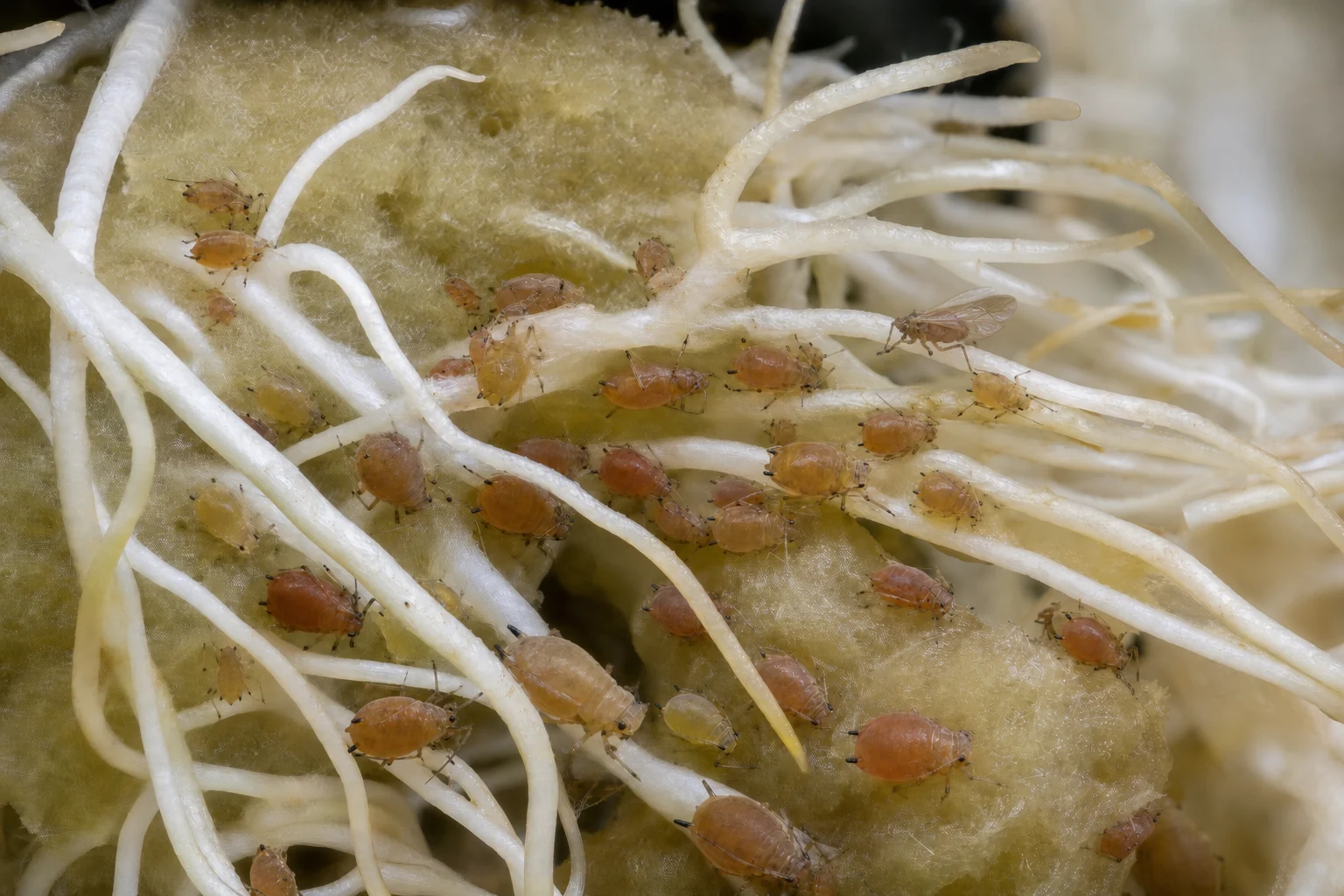
AI-generated educational reconstruction of rice root aphids colonising cannabis roots
Example. Soft, pear-shaped root-zone aphids in cream, amber or brown colonies, often with waxy residue. Winged alates may appear on low sticky cards. Cornicles and an aphid body plan separate them from fungus gnats. Generated plate; not to scale and apparent magnification varies.OpenAI image generation
Earliest reliable signsUnexplained yellowing, stunting, weak water response, sticky or waxy material around the root crown, and colonies on roots or the pot base. Above-ground symptoms are nonspecific.
Life cycle and spreadWingless colonies feed below ground; crowded populations produce winged dispersers. They can move with rooted cuttings, loose media, pots, runoff and shared handling.
Condition-qualified developmentA complete indoor generation may take roughly 10-14 days under favourable root-zone conditions; host, temperature and media can shift that window. Include live-born immature/nymph, wingless adult and winged alate stages in the survey.
Size / inspection scalePlate is uncalibrated. Colonies are visible at whole-root scale; use about 30x-60x hand-lens or microscope inspection to resolve cornicles, antennae and alate body form.
Where to inspectLift root-zone covers, inspect the crown, root ball edge, drainage holes and bench debris. Place yellow cards just above the media and preserve unknown alates.
ConfirmationMicroscopy or specialist identification. Compare antennae, cornicles and body shape against fungus-gnat adults before selecting control.
LookalikesFungus-gnat adults, nutrient/root-zone stress, Pythium and overwatering.
Internal thresholdZero tolerance in quarantine, foundation mothers, production mothers and clone rooms. Any confirmed colony in production triggers containment and linked-lot inspection.
First responseIsolate the zone; bag severe plants; stop moving pots/media; inspect linked mothers and clone lots; correct standing water and algae; select only currently lawful root-zone biological or input options; recheck roots and low traps on the approved interval.
Layered control optionsCultural: exclude infested stock/media, segregate pots and clean spills. Environmental: remove standing water and algae without stressing roots. Biological: consider lawful root-zone predators or nematodes matched to the target stage. Approved input: only a registered or documented exempt root-zone use that passes the NZ legal gate.
Target stage and plant partTarget exposed colonies and mobile immature stages on roots/crown; monitor alates on cards just above media. Canopy-only treatment does not reach the colony.
Crop, worker, residue and compatibility constraintsQuarantine and mother stock remain zero tolerance. Verify organism/product status, root-zone use, beneficial compatibility, crop stage, label PPE/REI and residue implications before treatment.
Specimen handlingBag a labelled root/crown sample with some live colony material; preserve low-card alates separately; record plant, lot, room, root zone and collection time under chain of custody.
Dated recheck and success criterionReinspect mapped roots and low cards after the approved intervention interval and again over one expected generation; success means no live colony or new alates and no linked-plant spread.
Trace-back and CAPA triggerTrace source genetics, media/pot lots, irrigation/runoff links, benches, tools and staff movement; hold linked clone lots until the source and spread route are resolved.

Profile evidence: [14][11]

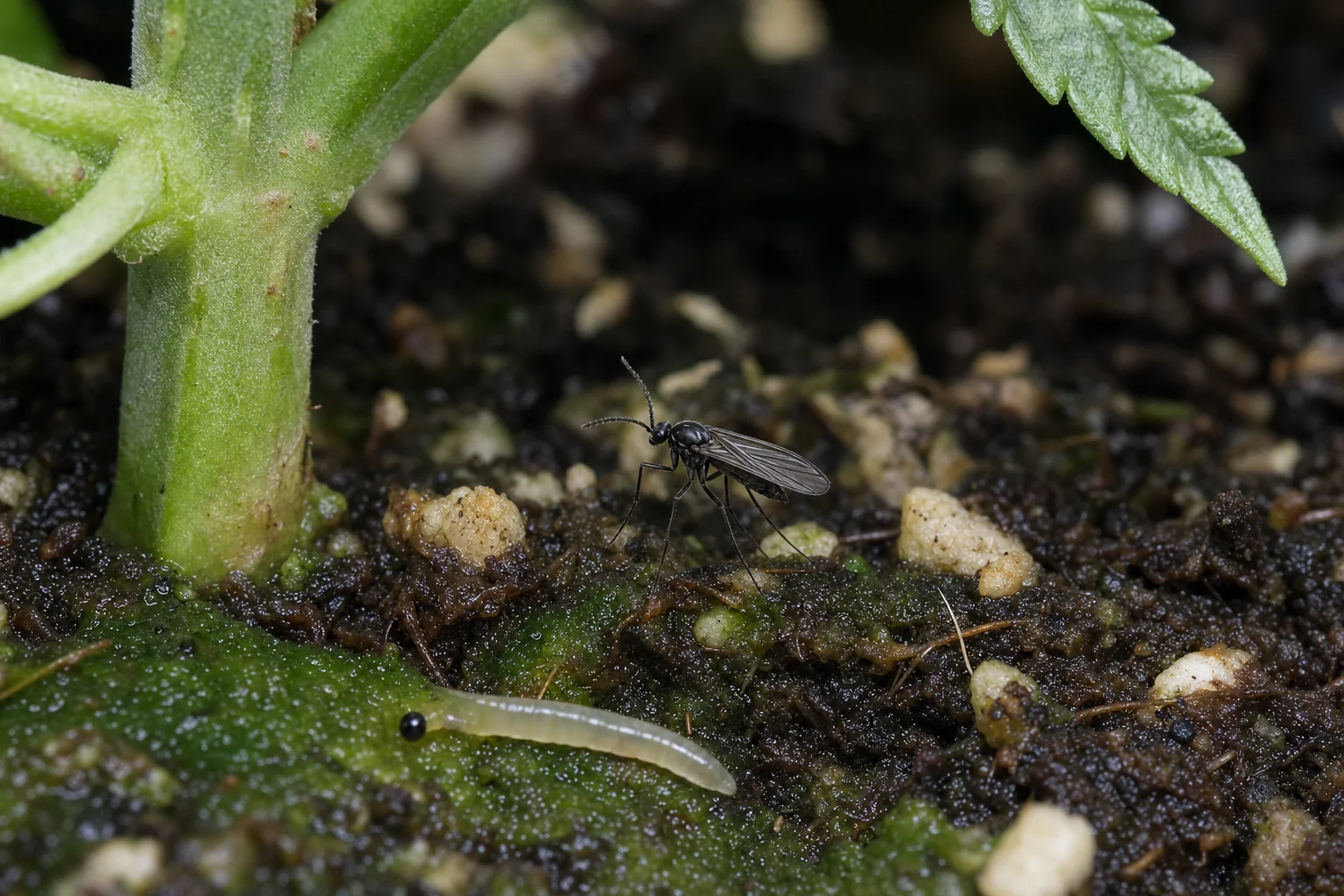
2. Fungus gnats (Bradysia species)

AI-generated educational reconstruction of fungus gnat adult and larva at cannabis media
Example. Adults are delicate dark flies with long legs and antennae. Larvae are translucent, legless and wormlike with a distinct shiny black head capsule. Generated plate; not to scale and apparent magnification varies.OpenAI image generation
Earliest reliable signsAdults run or fly weakly over wet media; larvae occur near algae, decaying roots and biofilm. Root-hair feeding can slow young plants and wounds can interact with root disease.
Life cycle and spreadEgg and larval stages are in the medium, followed by a pupa and flying adult. Canopy-only treatment misses most of the population.
Condition-qualified developmentEgg-to-adult development is commonly about 18-28 days, with temperature, moisture, substrate and food strongly affecting the interval. Track egg, larva, pupa and adult rather than treating card counts as the whole population.
Size / inspection scalePlate is uncalibrated. Adults are roughly 2-4 mm long and visible over media; use about 30x-60x to confirm the larval black head capsule or adult venation/body form.
Where to inspectRead low yellow cards, use potato slices or media samples for larvae, and inspect irrigation uniformity, standing water, algae and organic debris.
ConfirmationAdult wing venation/body form or larval black head under a loupe or microscope. Preserve specimens if root aphid alates are possible.
LookalikesWinged root aphids, shore flies, harmless small flies, Pythium-driven poor rooting.
Internal thresholdAny larvae in propagation deserve action. Elsewhere use a site-set trend threshold; a rising multi-card trend matters more than one adult.
First responseDry the media surface within crop limits, remove algae and leaks, clean drains, target larvae with an approved root-zone biological programme, and use cards to verify adult decline over the next life cycle.
Layered control optionsCultural: remove algae, debris and wet reservoirs and repair leaks. Environmental: allow a crop-safe surface dryback and correct poor drainage. Biological: use lawful nematodes or media predators against larvae. Approved input: restrict any drench or surface treatment to its authorised use and target stage.
Target stage and plant partTarget larvae in the upper moist substrate/root zone; cards monitor adults but do not control the damaging stage. Coordinate media and adult monitoring across one full cycle.
Crop, worker, residue and compatibility constraintsDo not force dryback beyond crop limits. Check root-biological compatibility, irrigation-system effects, crop stage, label PPE/REI and residue route before any input.
Specimen handlingSeal labelled adults/card sections and a separate media/root sample containing larvae; preserve the plant, zone, trap height and moisture context and submit unknowns for microscopy.
Dated recheck and success criterionCount live larvae in the same media sites and adults on the same mapped cards at the site-set interval through one expected generation; success is a sustained falling trend with no propagation root injury.
Trace-back and CAPA triggerInvestigate irrigation uniformity, leaks, algae/biofilm, drains, incoming media, propagation hygiene and any coincident root-disease pattern.

Profile evidence: [17][11]

3. Thrips (Frankliniella occidentalis and other thrips species)
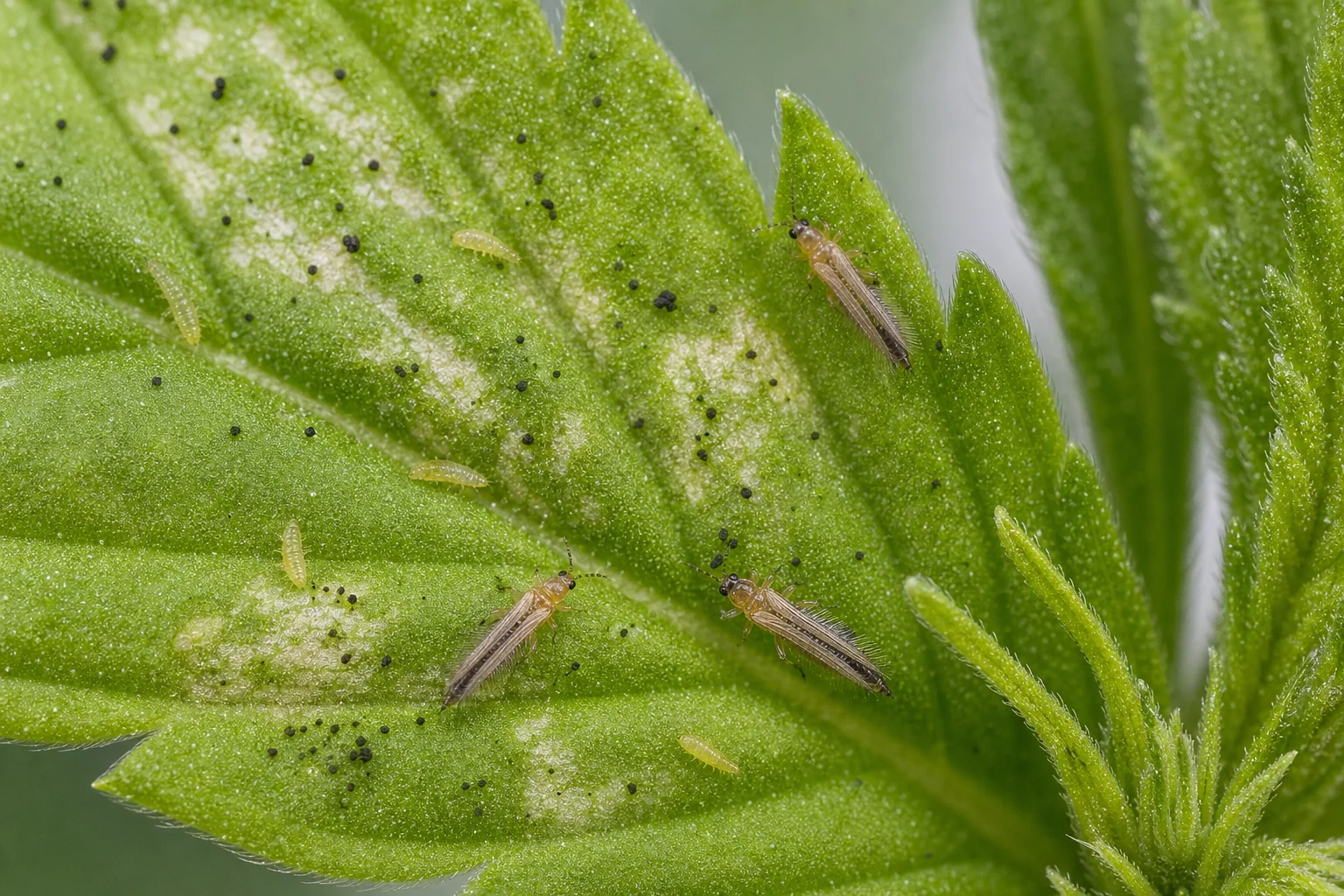
AI-generated educational reconstruction of thrips and feeding injury on cannabis
Example. Slender adults with narrow fringed wings; smaller pale larvae. Feeding scrapes cells into silvery streaks or patches, usually with black frass dots. Generated plate; not to scale and apparent magnification varies.OpenAI image generation
Earliest reliable signsSilvering, distorted young leaves, flower scarring and dark specks. Adults and larvae hide in folds and flowers; prepupae and pupae may be in media or debris.
Life cycle and spreadEggs are inserted into plant tissue, larvae feed on the plant, then non-feeding stages occur in protected sites before adults return to the canopy.
Condition-qualified developmentA generation often takes about 14-21 days under warm indoor conditions, but species and temperature matter. Eggs are embedded in tissue, larvae feed on the crop, prepupae/pupae occupy protected sites and adults disperse.
Size / inspection scalePlate is uncalibrated. Adults and larvae require close plant-part inspection; use about 30x-60x to resolve pale larvae, fringed adult wings and embedded-egg or species detail.
Where to inspectBlue or yellow cards, tap flowers over white paper, inspect young folded leaves and flowers, and sample media/debris where pupation occurs.
ConfirmationLoupe or microscopy; species confirmation matters when choosing specialist biological control or assessing virus-vector risk.
LookalikesMechanical abrasion, wind burn, oedema and spray injury.
Internal thresholdZero tolerance in quarantine and clean stock. In production, a confirmed hotspot or rising repeated card trend triggers the site response level.
First responseContain the hotspot, remove heavily damaged tissue without scattering insects, target canopy and protected/off-plant stages, verify biological compatibility, and re-read mapped cards after the defined recheck window.
Layered control optionsCultural: exclude infested stock, bag hotspots and remove debris. Environmental: reduce protected weeds/debris and correct unsuitable canopy conditions. Biological: use lawful predators or parasitoids matched to species and stage. Approved input: choose a legal contact or microbial option that reaches the target without collapsing beneficials.
Target stage and plant partTarget feeding larvae on young leaves/flowers and protected prepupal/pupal sites; adults and embedded eggs require monitoring and repeat timing rather than assuming one contact pass is complete.
Crop, worker, residue and compatibility constraintsSpecies can determine biological fit. Flower contact, beneficial residues, crop-stage quality, label PPE/REI and analytical residue consequences constrain input choice.
Specimen handlingCollect larvae and adults from a mapped hotspot into labelled sealed vials and retain a symptomatic leaf/flower separately; preserve card ID and plant-part context for specialist identification.
Dated recheck and success criterionRepeat tap tests, plant inspection and mapped card counts at the approved interval through one expected generation; success is no feeding larvae and a falling adult trend without expansion beyond the hotspot.
Trace-back and CAPA triggerTrace incoming plants, flowers/packaging, doors/screens, weeds, tools, staff sequence and substrate debris; investigate species if control performance or vector consequence differs.

Profile evidence: [12][11]

4. Two-spotted spider mite (Tetranychus urticae)
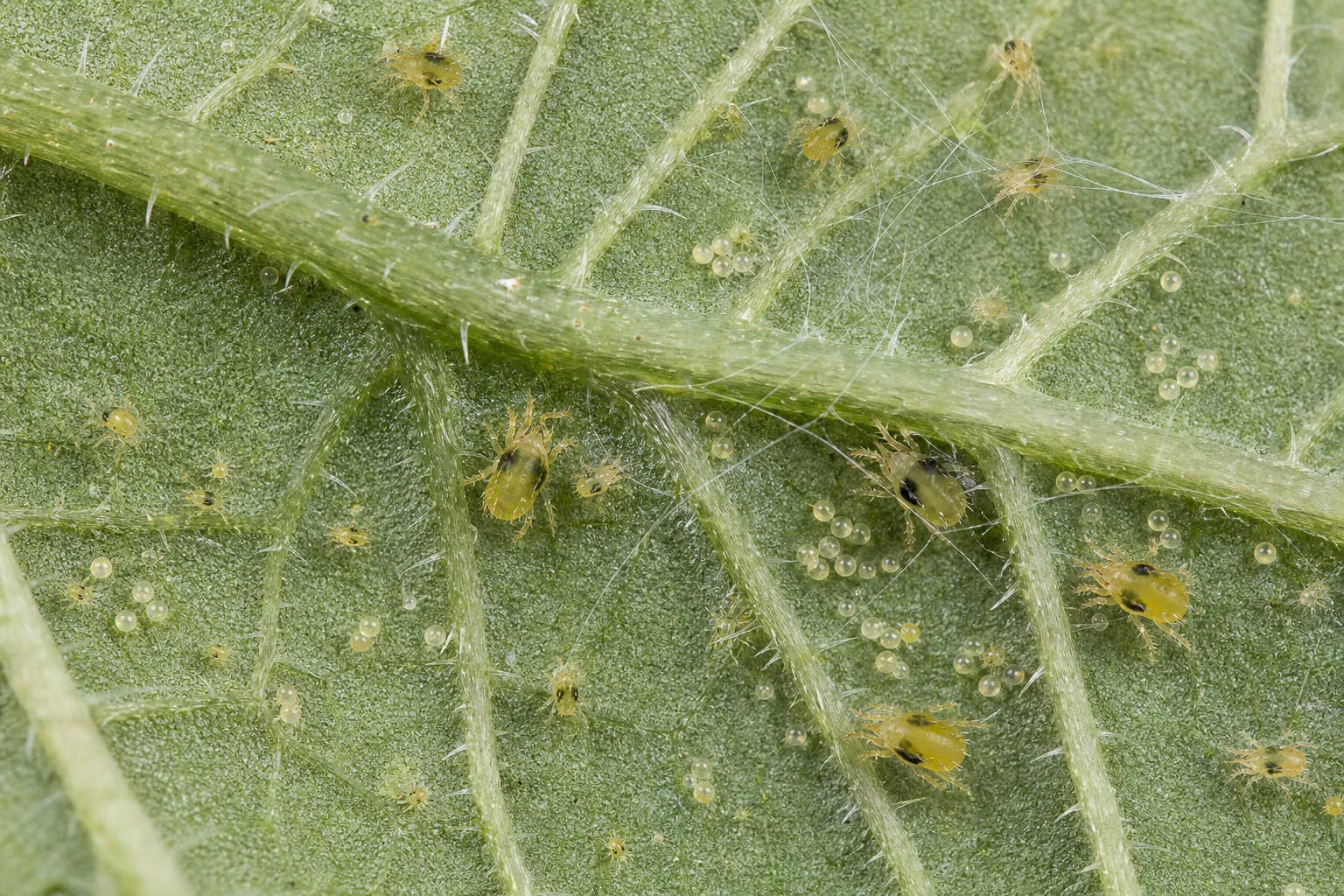
AI-generated educational reconstruction of two-spotted spider mites, eggs and webbing on cannabis
Example. Oval mites with two dark lateral patches, round translucent eggs and colonies on leaf undersides. Fine silk appears as pressure rises. Generated plate; not to scale and apparent magnification varies.OpenAI image generation
Earliest reliable signsFine pale stippling progresses to bronzing, leaf decline and webbing over petioles, shoots and flowers. Hot, dry canopy pockets often show first.
Life cycle and spreadEgg, six-legged larva, nymphal stages and adult can overlap. Development accelerates strongly with warmth, so a small patch can change rapidly.
Condition-qualified developmentEgg to adult may take roughly 7-14 days, accelerating as canopy temperature rises. Survey egg, six-legged larva, protonymph/deutonymph and adult because overlapping stages are normal indoors.
Size / inspection scalePlate is uncalibrated. Inspect individual leaf undersides with a 10x-30x loupe; use microscopy where the two-spot pattern, eggs or beneficial-mite distinction is uncertain.
Where to inspectMap hot/dry zones, inspect leaf undersides with a 10x-30x loupe, tap foliage over white paper and trace webbing back to live colonies.
ConfirmationMicroscopy for the two-spotted adult pattern and life stages. Distinguish from beneficial mites before treatment.
LookalikesSpray stipple, nutrient flecking, dust and beneficial mites.
Internal thresholdAny confirmed colony in quarantine or mothers. In veg/flower, a single reproducing hotspot is enough to trigger containment rather than wait for webbing.
First responseFlag and isolate the hotspot, restrict staff/tool movement, remove the worst leaves into bags, correct extreme hot/dry pockets, release the approved predator programme or lawful compatible control, and verify live-mite decline rather than judging leaf damage that cannot heal.
Layered control optionsCultural: exclude infested stock, bag hotspot leaves and prevent contact spread. Environmental: correct extreme hot/dry pockets without creating disease risk. Biological: deploy a currently lawful predatory-mite programme early. Approved input: use only a compatible legal contact or microbial option with adequate underside access.
Target stage and plant partTarget live mites and eggs on leaf undersides and the leading edge of hotspots; webbed flowers and protected colonies are harder to reach and carry higher quality consequence.
Crop, worker, residue and compatibility constraintsOld stippling is not an efficacy measure. Check predator residues, flower contact, crop stage, label PPE/REI, residue route and phytotoxicity before any input.
Specimen handlingBag labelled leading-edge leaves with live mites, keep samples cool and intact, and submit a separate slide/tape preparation if required; record hotspot temperature and plant location.
Dated recheck and success criterionRecount live mites and eggs on the same mapped leaves plus the hotspot edge after the approved interval and again before one expected generation closes; success is no outward spread and a sustained live-stage decline.
Trace-back and CAPA triggerTrace plant contact, staff/tools, carts, incoming stock and hot/dry dead zones; review delayed detection and any incompatible residue that prevented predator establishment.

Profile evidence: [12][11]

5. Broad mite (Polyphagotarsonemus latus)
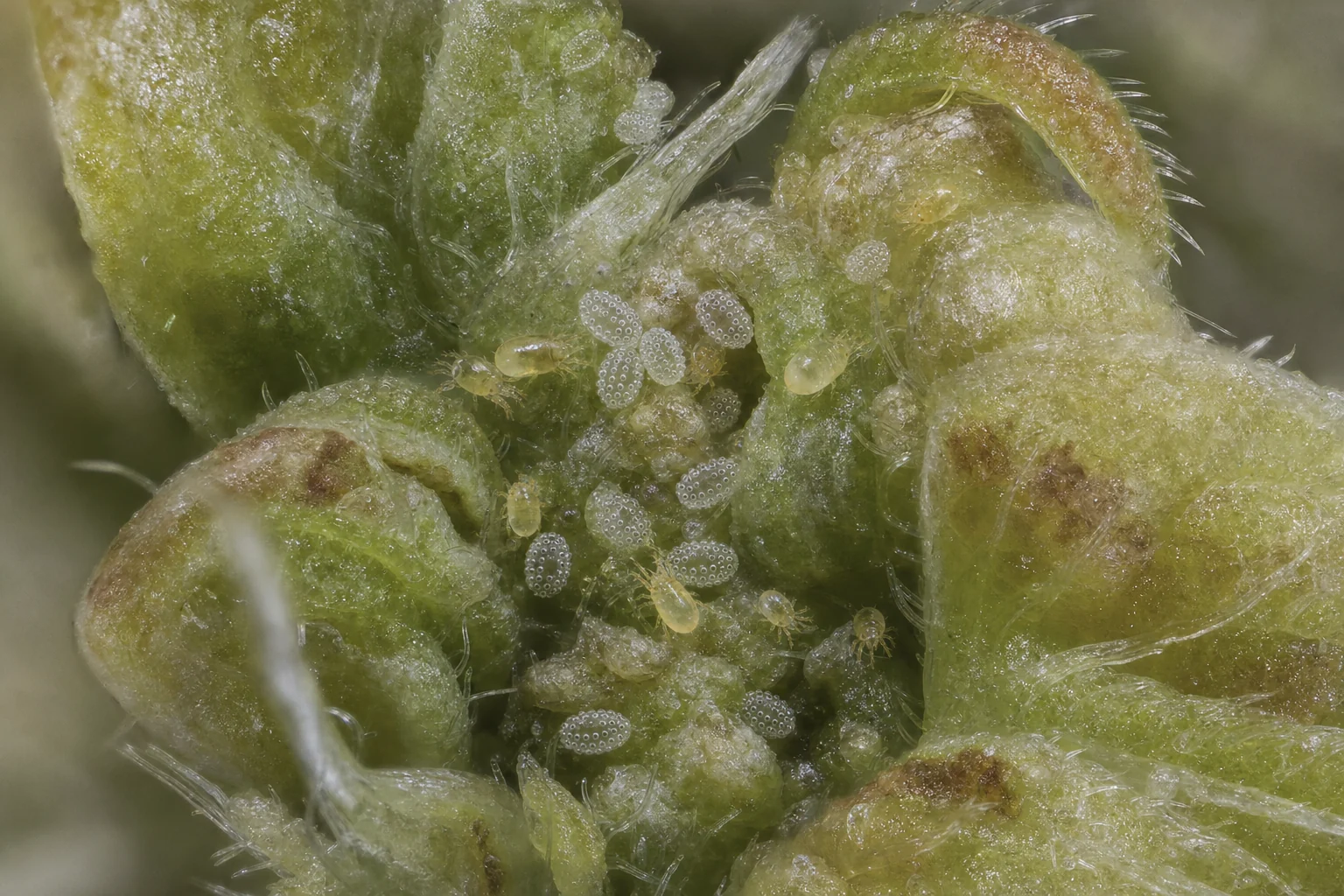
AI-generated educational reconstruction of broad mites and ridged eggs on cannabis meristem
Example. Microscopic, pale mites on tender tissue. Eggs are diagnostically useful: oval and ornamented with pale raised dots or ridges. Generated plate; not to scale and apparent magnification varies.OpenAI image generation
Earliest reliable signsHardened, blistered, glossy or twisted new growth, short internodes and damaged meristems. Symptoms can remain after mites are gone.
Life cycle and spreadBroad mites concentrate on protected new growth and can be carried on plant material, workers and equipment. Their size makes visual scouting alone unreliable.
Condition-qualified developmentA warm, humid crop can support a generation in roughly 4-7 days. Include ornamented egg, six-legged larva, quiescent/protected nymphal transition and microscopic adult when timing controls.
Size / inspection scalePlate is uncalibrated. Adults are under about 0.2 mm; inspect intact meristems and characteristic eggs at roughly 20x-60x, escalating to compound microscopy for confirmation.
Where to inspectSample the youngest distorted tissue, petiole bases and shoot tips. Mount tape or leaf pieces for a dissecting/compound microscope.
ConfirmationMicroscopic mites plus characteristic eggs. Confirmation is required before changing nutrition or applying a rescue treatment.
LookalikesHeat/light tacoing, herbicide or spray injury, nutrient toxicity, viral/viroid stunting and genetic fasciation.
Internal thresholdZero tolerance in quarantine, mothers and propagation. Any confirmed production finding is high consequence because detection is late.
First responseIsolate and usually remove confirmed clean-stock plants; trace clones and movement; intensify tip sampling; choose a currently lawful, crop-stage-compatible control; verify on new growth and microscopy, not on old distorted leaves.
Layered control optionsCultural: reject infested stock, isolate tips and remove confirmed clean-stock plants. Environmental: correct excess heat/humidity without imposing a universal setpoint. Biological: use a currently lawful predator with evidence for broad-mite stages. Approved input: limit use to a legal meristem-contact option compatible with predators and crop stage.
Target stage and plant partTarget eggs and mobile mites within meristems, folded leaves and petiole bases; protected/quiescent stages and hidden tissue make coverage and repeat timing critical.
Crop, worker, residue and compatibility constraintsDiagnosis requires microscopy because symptoms persist after mites are gone. Protect beneficials and verify flower contact, crop stage, label PPE/REI, residues and phytotoxicity before inputs.
Specimen handlingCollect several intact symptomatic shoot tips from the leading edge into labelled sealed bags, keep cool, and prepare tape/leaf mounts under the laboratory method without crushing the meristem.
Dated recheck and success criterionMicroscope multiple new tips from the hotspot and its perimeter after the approved interval and through one expected generation; success is repeated absence of live mites/eggs and normal new growth with no spatial expansion.
Trace-back and CAPA triggerTrace source plants/clones, worker and tool movement, carts, nearby crops and any treatment that masked symptoms; hold linked propagation material until microscopy clears it.

Profile evidence: [16][12][11]

6. Hemp russet mite (Aculops cannabicola)
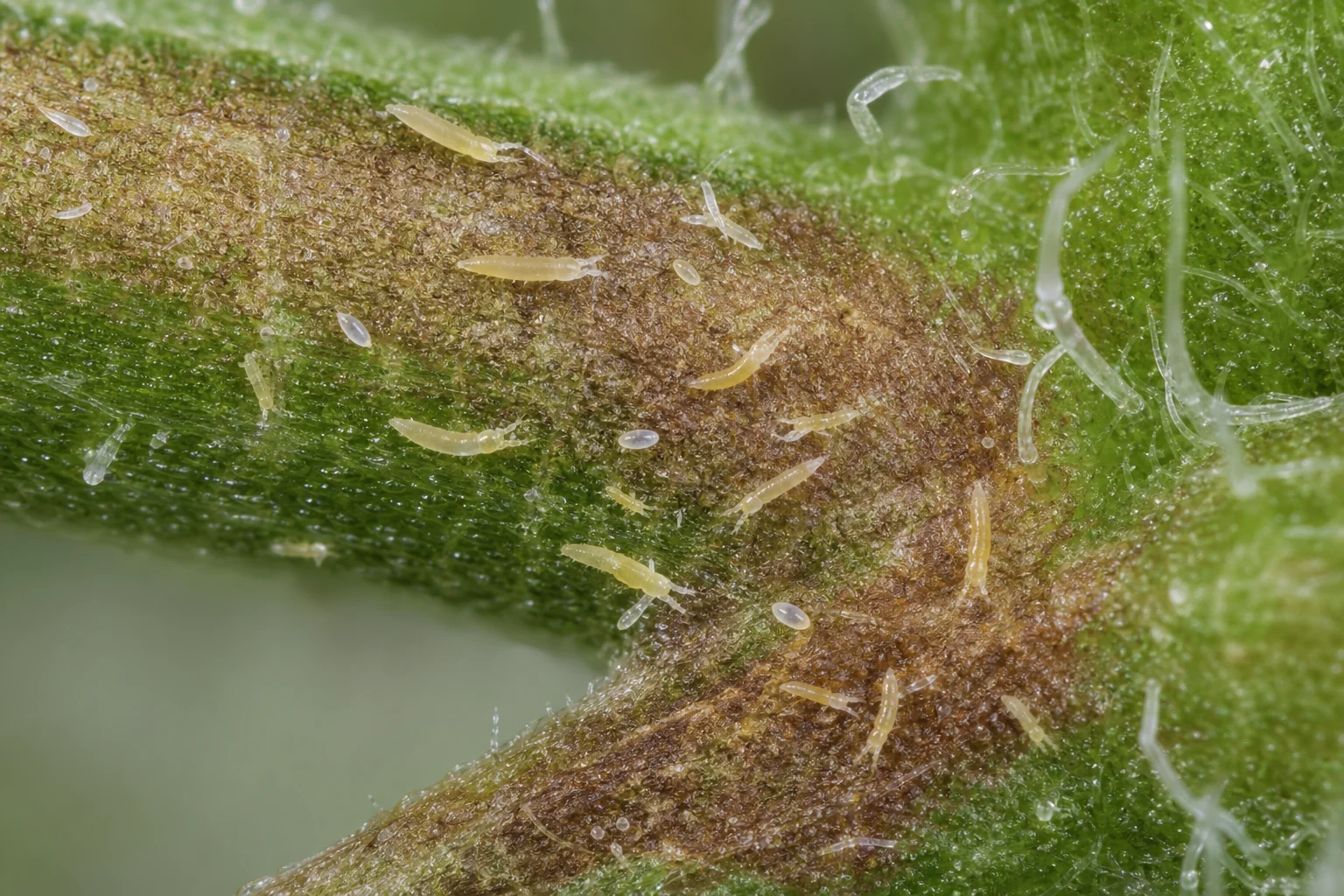
AI-generated high-magnification educational reconstruction of hemp russet mites on cannabis
Example. Extremely small, pale, tapered and wormlike eriophyid mites with only two pairs of legs near the head. High magnification is mandatory. Generated plate; not to scale and apparent magnification varies.OpenAI image generation
Earliest reliable signsDull bronzing or russeting, brittle petioles, curled margins, weak new growth and declining flower quality. Damage may climb upward through the plant.
Life cycle and spreadMites aggregate on stems, petioles, leaf surfaces and flowers and can disperse on air currents, people, tools and plant contact.
Condition-qualified developmentA generation may take roughly 7-10 days in favourable warm indoor conditions, with host and environment changing the interval. Track egg, larva, nymph and tapered adult; all active stages retain two pairs of legs near the head as populations migrate upward.
Size / inspection scalePlate is uncalibrated. Adults are under about 0.2 mm and eggs may be around 20 micrometres; inspect multiple stem, petiole and flower samples at roughly 60x-100x or use a diagnostic laboratory.
Where to inspectTake multiple samples from the leading edge of symptoms, including petioles, stems and flowers. Use roughly 60x-100x or a diagnostic lab.
ConfirmationSpecialist microscopy; absence in one sample does not clear a symptomatic plant because distribution is patchy.
LookalikesBroad-mite injury, heat/light tacoing, nutrient problems, drought and HLVd-associated poor vigour.
Internal thresholdZero tolerance in quarantine, mothers and propagation. A single confirmed production plant triggers containment and trace-back.
First responseStop plant contact and movement, bag confirmed plants as the site procedure directs, sample linked cohorts, review airflow/tool vectors, apply only currently lawful compatible measures within the crop-stage window, and require repeated negative microscopy before closure.
Layered control optionsCultural: exclude infested stock, stop plant contact and bag confirmed high-consequence plants. Environmental: review airflow and heat/dry stress without treating climate as eradication. Biological: use only a lawful predator with evidence for eriophyid mites. Approved input: select a legal high-magnification-confirmed tactic compatible with crop stage and existing biologicals.
Target stage and plant partTarget the symptom-leading edge on stems, petioles, young leaves and flowers; multiple plant heights must be sampled because mites migrate upward and distribution is patchy.
Crop, worker, residue and compatibility constraintsHigh-magnification confirmation is mandatory. Late flower sharply limits crop-contact options; verify beneficial compatibility, label PPE/REI, residues, quality and phytotoxicity.
Specimen handlingCollect several labelled stem, petiole, leaf and flower pieces from the leading edge and linked asymptomatic plants, keep cool and sealed, and submit intact for specialist microscopy.
Dated recheck and success criterionRepeat 60x-100x or laboratory counts at the same mapped heights and leading edge after the approved interval and across one expected generation; closure requires repeated negative samples and no new upward spread.
Trace-back and CAPA triggerTrace genetics, clone cohorts, plant contact, airflow, staff/tools and sampling sensitivity; hold linked clean-stock material and review any false-negative clearance.

Profile evidence: [12][11]

7. Whiteflies (Trialeurodes vaporariorum, Bemisia tabaci complex and related species)
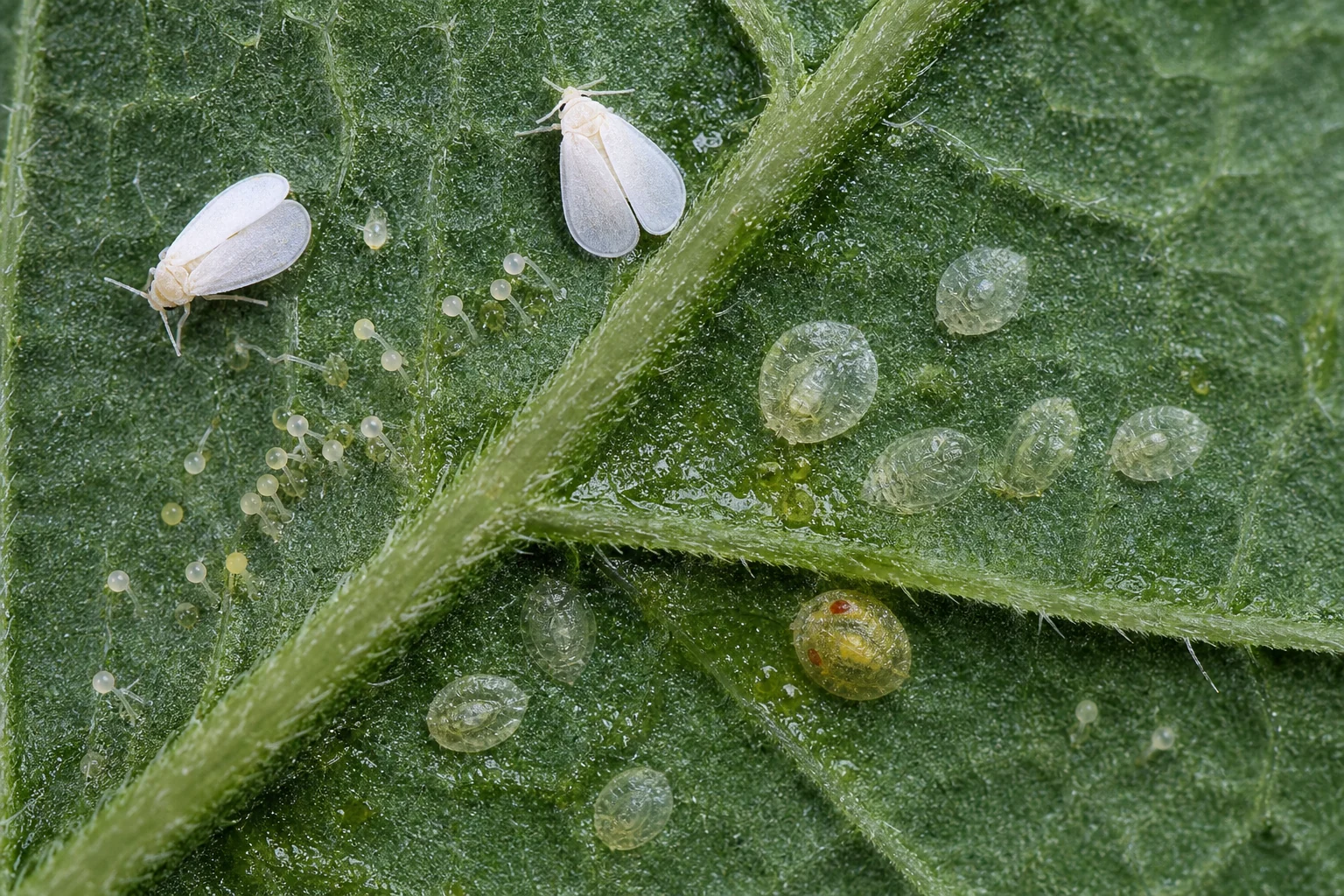
AI-generated educational reconstruction of whitefly adults and nymphs on cannabis leaf underside
Example. White, powdery, moth-like adults flush from the leaf underside. Eggs, crawlers and flat scale-like nymphs remain on the underside; older nymphs may show red eyes. Generated plate; not to scale and apparent magnification varies.OpenAI image generation
Earliest reliable signsGeneral chlorosis, honeydew, sooty mould and clouds of adults when foliage is disturbed. Nymphal stages are easy to miss.
Life cycle and spreadOnly the first nymphal crawler moves far; later nymphs are fixed feeders. Species and stage affect parasitoid performance and control choice.
Condition-qualified developmentEgg to adult commonly takes about 21-28 days under warm indoor conditions, but species and temperature change the range. Include egg, mobile crawler, fixed scale-like nymph/red-eye stage and winged adult.
Size / inspection scalePlate is uncalibrated. Adults are roughly 1-2 mm and visible when flushed; inspect underside eggs, crawlers, fixed nymphs and red-eye stages at about 30x-60x, with specialist microscopy for species.
Where to inspectTurn lower and mid-canopy leaves, count nymph-bearing leaves, use yellow cards at canopy height, and inspect honeydew/sooty mould sites.
ConfirmationMicroscopy or specialist species identification when the biological programme depends on species.
LookalikesPowdery mildew, small moths, cast aphid skins and harmless white debris.
Internal thresholdZero tolerance at entry. In production, any reproducing underside colony or rising card trend triggers action before adults spread.
First responseContain the zone, remove heavily colonised leaves into bags, improve underside scouting, deploy only approved species-matched biologicals or compatible lawful inputs, and verify both adult cards and live nymphs.
Layered control optionsCultural: exclude infested plants, bag colonised leaves and control weeds/reservoirs. Environmental: correct stagnant hot spots without creating excess humidity. Biological: use lawful predators or parasitoids matched to the confirmed species. Approved input: use only a legal underside-targeted option compatible with parasitoids and crop stage.
Target stage and plant partTarget crawler and young nymph stages on leaf undersides while monitoring adults on yellow cards; fixed older nymphs and eggs may require stage-timed follow-up.
Crop, worker, residue and compatibility constraintsSpecies affects parasitoid fit. Check flower contamination, honeydew/sooty mould, beneficial residues, label PPE/REI, crop stage and residue release before inputs.
Specimen handlingBag labelled underside leaves carrying eggs and nymphs; preserve representative adults/card sections separately; record plant height, card position and any honeydew before specialist identification.
Dated recheck and success criterionCount live nymphs on the same mapped leaves and adults on the same cards at the approved interval through one expected generation; success is no new colonies and a sustained decline in both measures.
Trace-back and CAPA triggerTrace incoming plants, weeds, doors/vents/screens, staff/tools and species mismatch in biological releases; assess sooty mould and affected product surfaces.

Profile evidence: [12][11]

8. Foliar aphids (Phorodon cannabis, Myzus persicae, Macrosiphum euphorbiae and others)
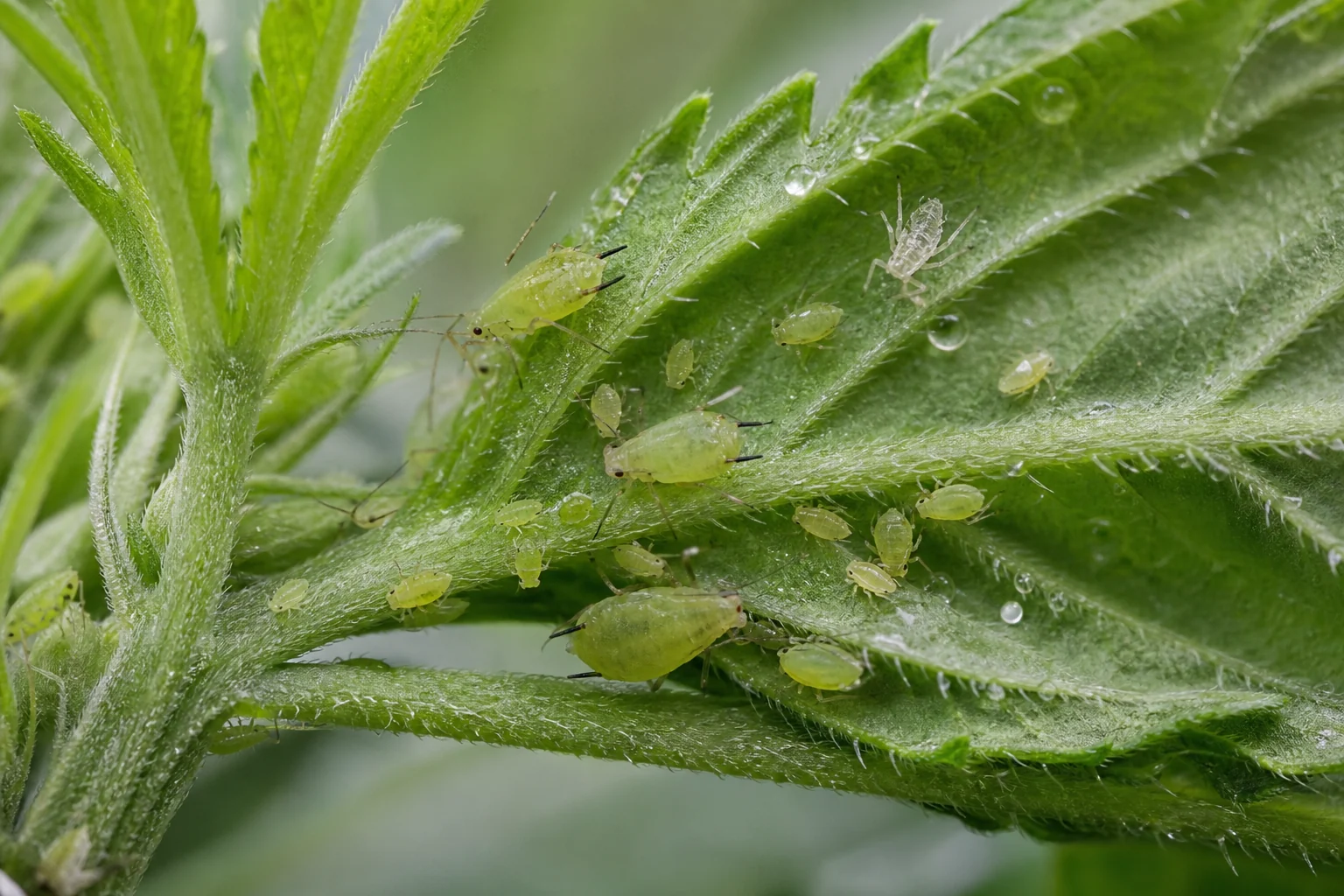
AI-generated educational reconstruction of cannabis aphids on a cannabis shoot
Example. Soft pear-shaped insects with paired cornicles near the rear. Colonies contain nymphs, wingless adults, cast white skins and sometimes winged adults. Generated plate; not to scale and apparent magnification varies.OpenAI image generation
Earliest reliable signsClusters on shoots, stems, leaf undersides or flowers; curled/distorted growth; sticky honeydew and secondary sooty mould.
Life cycle and spreadFemales can produce live nymphs without mating under crop conditions, so colonies build quickly. Crowding produces winged dispersers.
Condition-qualified developmentUnder warm indoor conditions a clonal aphid generation may be roughly 7-10 days. Live-born nymphs mature into wingless adults; crowding and stress can produce winged dispersers, with overlapping generations.
Size / inspection scalePlate is uncalibrated. Colonies and adults are visible on shoots and undersides; use about 30x-60x to resolve cornicles, cast skins, nymphs and species-level characters.
Where to inspectExamine meristems, leaf undersides, petioles and flowers; map honeydew; read yellow cards for alates; distinguish aphids from beneficial larvae.
ConfirmationSpecies-level identification when choosing specialist parasitoids. Cannabis aphid, green peach aphid and potato aphid are not interchangeable targets.
LookalikesWhitefly nymphs/cast skins, scale insects, beneficial larvae and root aphid alates.
Internal thresholdZero tolerance in clean stock. A single reproducing colony in production triggers local containment and a same-room survey.
First responseBag severely infested tips, control ant activity if present, avoid spreading honeydew on tools/PPE, select species-appropriate lawful biologicals or compatible input, and recheck living aphids and new nymph production.
Layered control optionsCultural: exclude stock, bag infested tips, control ants and remove weeds. Environmental: correct plant stress without assuming climate alone will control aphids. Biological: use lawful predators or parasitoids matched to aphid species. Approved input: choose a legal contact or microbial option compatible with beneficials and crop stage.
Target stage and plant partTarget exposed nymphs and wingless adults on meristems, undersides, petioles and flowers; monitor alates on yellow cards and repeat for newborn nymphs.
Crop, worker, residue and compatibility constraintsSpecies-level identity can determine parasitoid success. Honeydew on flowers raises quality risk; verify beneficial residues, crop stage, label PPE/REI and residue consequences.
Specimen handlingCollect live wingless and winged adults plus nymphs from a mapped colony into labelled sealed vials; retain a symptomatic tip separately and record host plant part for specialist identification.
Dated recheck and success criterionRecount live aphids and newborn nymphs on the same marked tips plus alates on mapped cards after the approved interval and across one expected generation; success is colony extinction or an approved sustained decline without spread.
Trace-back and CAPA triggerTrace incoming stock, weeds, ants, staff/tools and species mismatch in the biological programme; assess honeydew contact and linked clean-stock lots.

Profile evidence: [13][12]

9. Budworms and caterpillars (Lepidopteran larvae; species confirmation required)
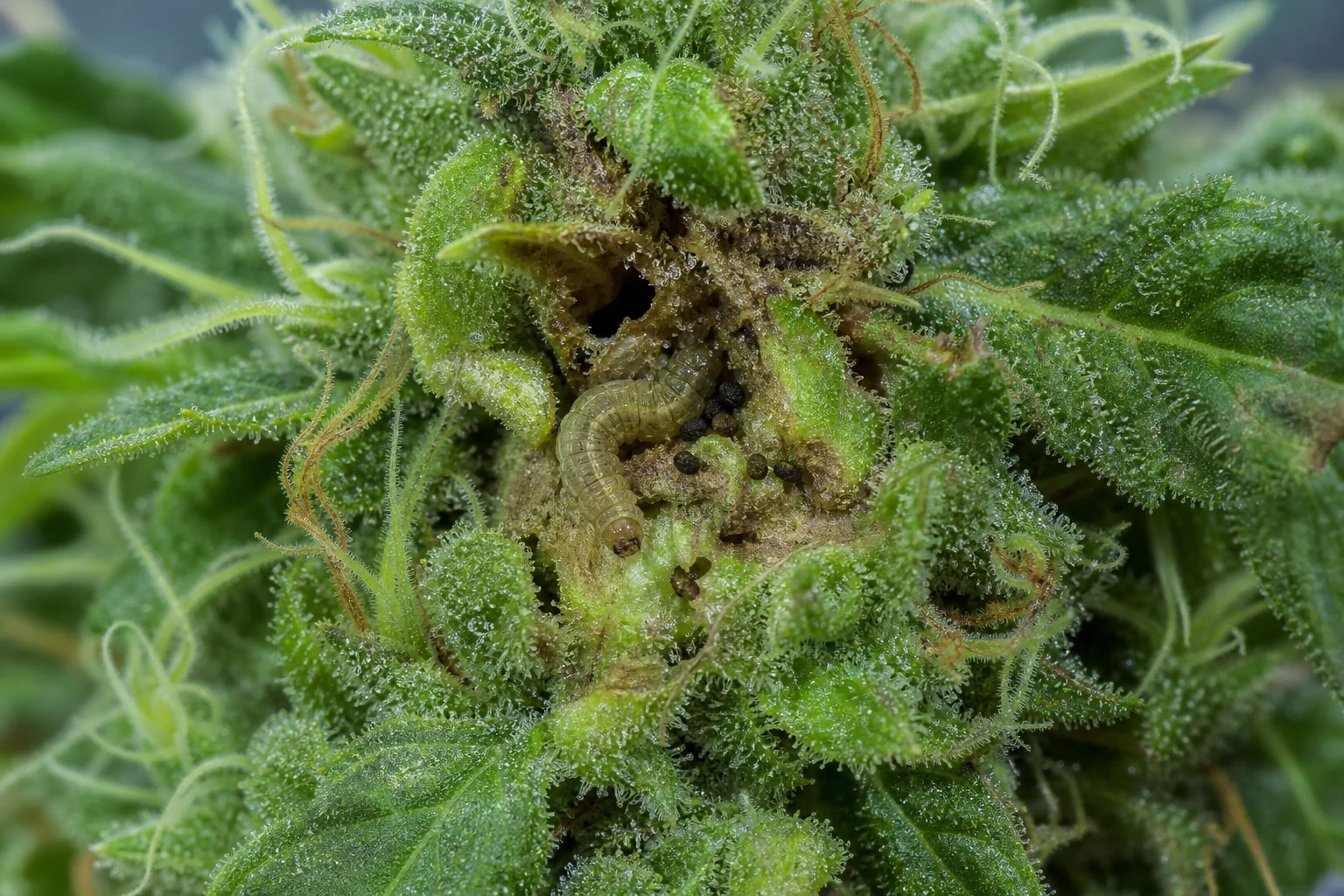
AI-generated educational reconstruction of caterpillar damage and frass inside a cannabis flower
Example. Chewing larva in foliage or flowers with bore holes and pellet-like frass. Flower injury can create a direct entry site for Botrytis. Generated plate; not to scale and apparent magnification varies.OpenAI image generation
Earliest reliable signsMissing tissue, bored flowers, frass, local browning and a wilted sugar leaf. Damage can be hidden until the flower is opened.
Life cycle and spreadEggs hatch to feeding larvae; later pupae and adults may be outside the crop. Exclusion is more reliable than trying to rescue late-flower injury.
Condition-qualified developmentDevelopment is species- and temperature-dependent; identify the larva before setting any interval. Treat egg, feeding larva, pupa and adult as distinct surveillance targets.
Size / inspection scalePlate is uncalibrated. Inspect the whole flower interior for larvae, bore holes and pellet-like frass; use about 30x-60x for eggs, very small larvae or diagnostic larval characters.
Where to inspectInspect entry points, screens, flowers with frass or wilted leaves, and conduct destructive checks where risk warrants it.
ConfirmationLarval morphology or specialist identification. Open damaged flower to separate feeding injury from primary Botrytis.
LookalikesBotrytis without an insect, mechanical flower damage and broken stems.
Internal thresholdZero tolerance in indoor production and any flower finding is an immediate quality event.
First responseRemove and bag the larva and affected flower, inspect neighbouring plants, close the entry route, assess secondary rot, and use only a lawful crop-stage-appropriate control where justified.
Layered control optionsCultural: maintain exclusion screens, inspect entries and bag larvae/damaged flowers. Environmental: remove outdoor host and entry pressure without compromising ventilation. Biological: consider only a lawful species-appropriate organism. Approved input: late-flower contact is a last-resort legal and quality decision, not a default.
Target stage and plant partTarget eggs or small exposed larvae before they enter flowers; once inside a cola, removal and secondary-rot assessment are more reliable than surface coverage.
Crop, worker, residue and compatibility constraintsSpecies confirmation matters. Any flower treatment must pass crop-stage, residue, microbial-quality, beneficial-compatibility, label PPE/REI and market-release review.
Specimen handlingSeal the larva with the damaged flower/frass in separate labelled containers, retain bore-site photographs and keep the specimen intact for specialist identification.
Dated recheck and success criterionInspect neighbouring flowers and entry points daily during the defined containment window; success is no new frass, bore holes, larvae or secondary rot through the site-set risk period.
Trace-back and CAPA triggerTrace doors, screens, incoming plants/materials, outdoor hosts, night work and staff movement; assess linked flowers and Botrytis risk as a quality event.

Profile evidence: [11]

10 · Field atlas

Diseases: symptoms point to the sample, not the answer

Disease symptoms overlap. Use them to choose tissue, environmental records and the right laboratory route. Do not convert a picture match into a release decision.

Cannabis disease literature supports distinct management for powdery mildew, Botrytis, Pythium, Fusarium and systemic propagation threats[20][21][22]. Septoria diagnosis is complicated by closely related species and requires more than lesion colour[27][28].

1. Powdery mildew (Golovinomyces and related powdery-mildew fungi on cannabis)
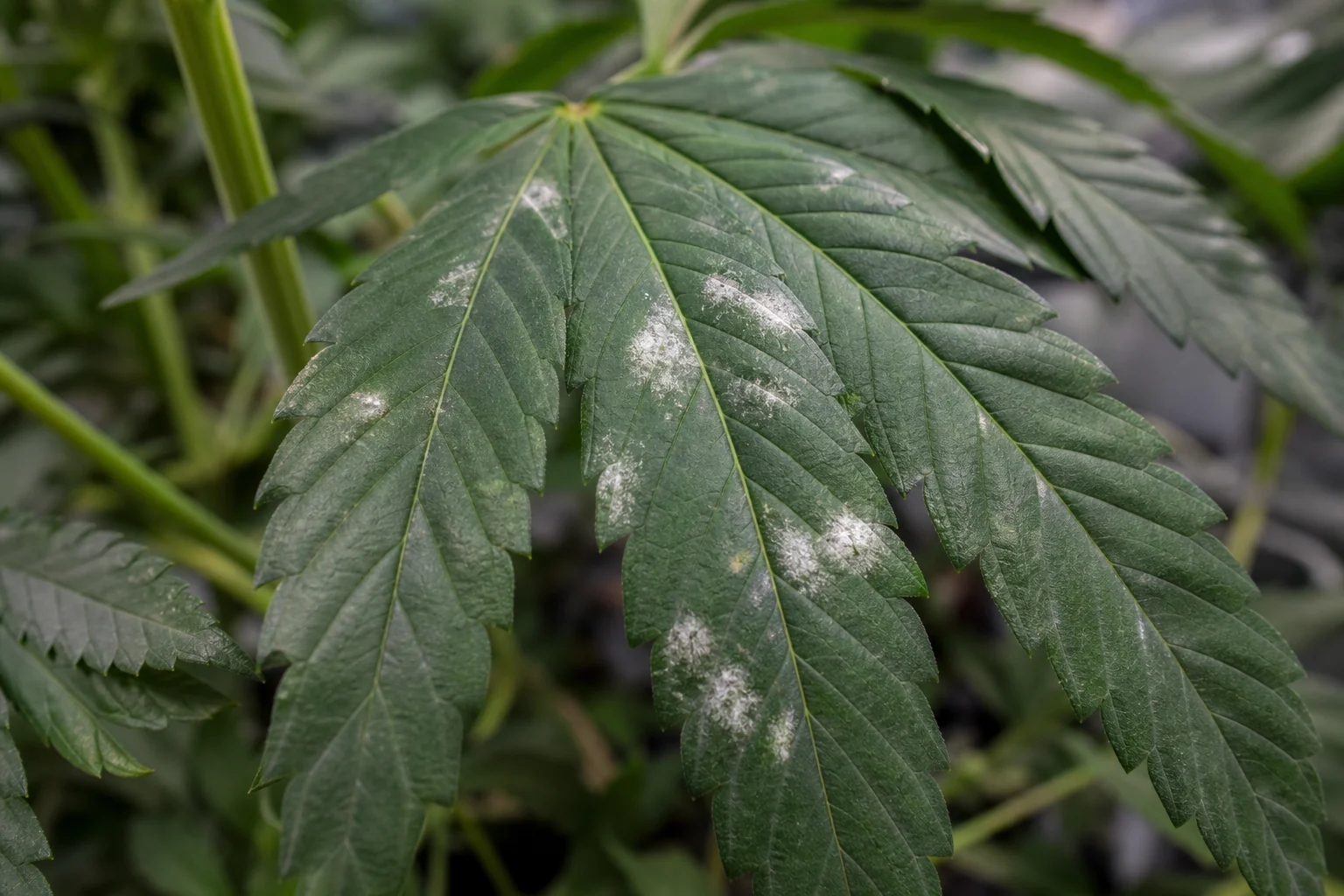
AI-generated educational reconstruction of early powdery mildew colonies on cannabis leaf
Example. Raised, patchy white colonies grow on living leaf, petiole, stem or flower surfaces. Early colonies are discrete rather than an even dusting. Generated plate; not to scale and apparent magnification varies.OpenAI image generation
Earliest reliable signsDull pale spots develop visible superficial mycelium and conidia. Colonies expand and produce repeated airborne secondary cycles.
Life cycle and spreadSuperficial fungal growth feeds from epidermal cells. Dense canopies, susceptible genetics and poor local air movement support spread even without free water.
Condition-qualified developmentUnder favourable canopy conditions, germination begins within hours and visible colonies/secondary conidia can develop over several days; cultivar and microclimate change the interval.
Size / inspection scalePlate is uncalibrated. Inspect whole leaves, stems and flowers under angled light, then examine a single colony at about 30x-60x; use microscopy or a laboratory when residue or trichomes remain plausible.
Where to inspectUse angled light on leaves and stems, inspect lower/inner canopy and flowers, map single colonies, and compare against recent spray records.
ConfirmationHand lens or microscopy for fungal structures; lab confirmation when dried spray/mineral residue, trichomes or dust create doubt.
LookalikesDried foliar spray, mineral residue, dust, trichomes and light reflection.
Internal thresholdZero tolerance in quarantine/mothers and any colony on flower. A single vegetative colony triggers containment and room-wide intensified scouting.
First responseBag affected tissue without shaking it, restrict room movement, correct canopy density and humid/dead-air pockets, use only a lawful crop-stage-compatible measure, and recheck new colonies rather than old scars.
Layered control optionsCultural: exclude infected stock, bag lesions and sanitise vectors. Environmental: correct dense dead-air and humidity/dew-point excursions. Biological: use only a lawful preventive antagonist with evidence for the target. Approved input: select a legal crop-contact option appropriate to tissue and stage.
Target stage and plant partTarget the first superficial colonies and new secondary spread on leaves/stems; flower infection is a quality event with far narrower intervention scope.
Crop, worker, residue and compatibility constraintsDo not confuse residue with infection. Flower contact, visible residues, beneficial compatibility, label PPE/REI, crop stage, phytotoxicity and analytical release constrain any input.
Specimen handlingPhotograph and bag an intact colony with adjacent healthy tissue using clean tools; retain recent spray records and submit dry/cool under the diagnostic laboratory instruction.
Dated recheck and success criterionUse angled light and microscopy at mapped sites after the approved interval and again within the expected secondary-cycle window; success is no new colonies and no expansion of existing sites.
Trace-back and CAPA triggerInvestigate source stock, staff/tools, airflow, canopy density, night humidity/dew point, cultivar susceptibility and affected flowers/batches.

Profile evidence: [20][19]

2. Botrytis bud rot (Botrytis cinerea)
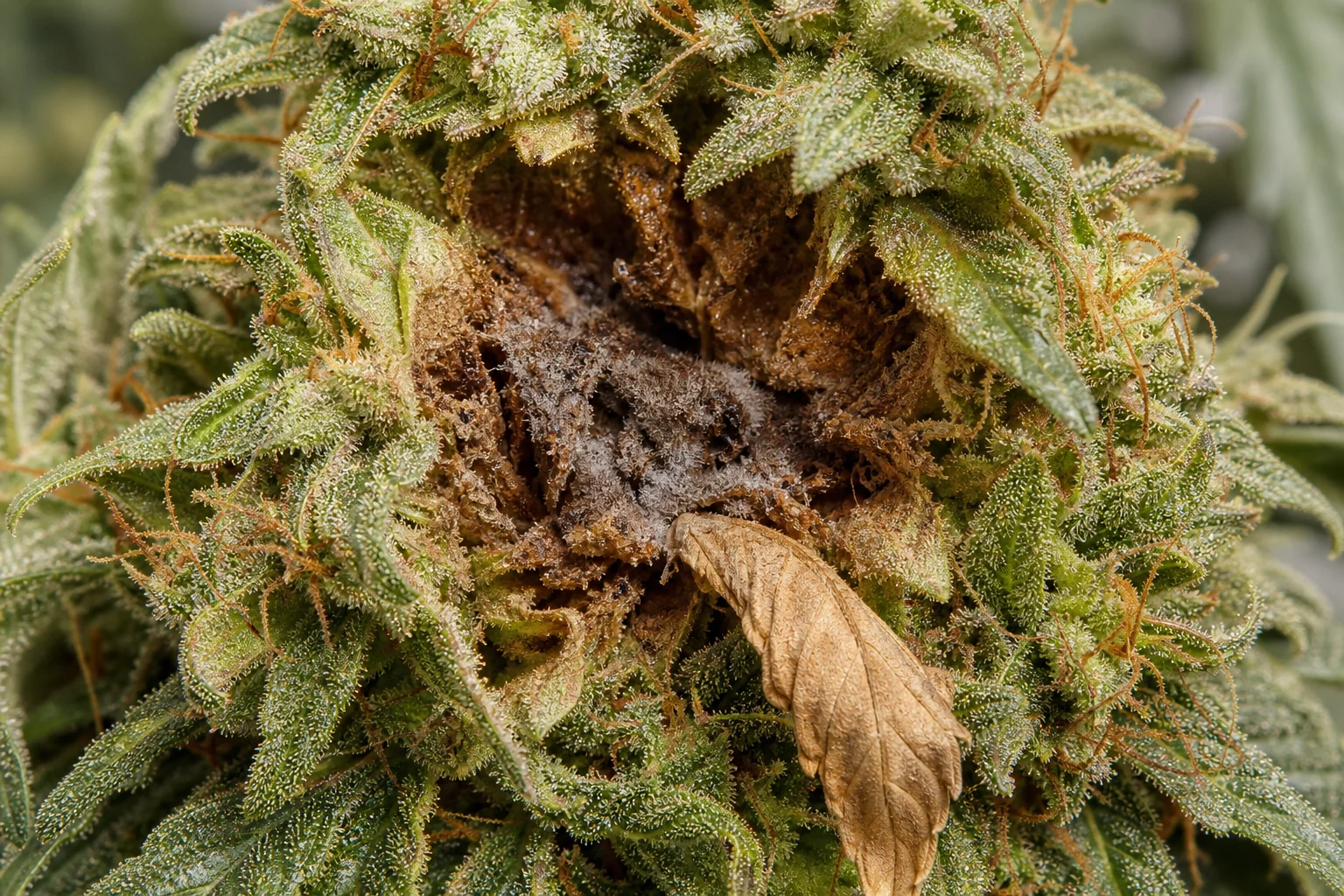
AI-generated educational reconstruction of internal Botrytis bud rot in a cannabis cola
Example. Internal flower tissue turns tan to brown and collapses; grey dusty sporulation may follow. A single wilted sugar leaf can be the first external clue. Generated plate; not to scale and apparent magnification varies.OpenAI image generation
Earliest reliable signsLocal leaf wilt, soft or dry necrosis within dense flower, grey mould and rapid spread through touching tissue under humid conditions.
Life cycle and spreadConidia enter susceptible, wounded or senescent tissue. Dense flowers create a humid microclimate; sclerotia and contaminated debris can carry inoculum between crops.
Condition-qualified developmentUnder sustained high humidity and susceptible tissue, infection may progress to visible necrosis/sporulation in roughly 3-5 days; temperature, wetness, wounds and flower architecture control the rate.
Size / inspection scalePlate is uncalibrated. Diagnose at whole-flower and opened-flower-interior scale, inspecting the lesion margin and sporulation with a hand lens; use laboratory microscopy/culture when species affects disposition.
Where to inspectDaily high-risk flower checks, with destructive opening of suspicious dense buds. Track cultivar, zone, irrigation events, night humidity and handling injuries.
ConfirmationCharacteristic internal necrosis and sporulation; diagnostic laboratory where quality disposition depends on species confirmation.
LookalikesCaterpillar damage, mechanical bruising, senescence and other flower rots.
Internal thresholdAny confirmed inflorescence is an immediate containment and batch-impact event.
First responseStop movement and fans that could spread spores during removal; bag a generous margin of affected material; inspect neighbours; hold implicated lot as site procedure requires; correct humidity/airflow/density; open CAPA if more than isolated.
Layered control optionsCultural: remove senescent/wounded tissue and bag affected flowers. Environmental: prevent condensation, prolonged wetness and dense stagnant flower zones. Biological: use only a lawful preventive antagonist with relevant evidence. Approved input: late-flower use requires explicit legal, quality and residue approval.
Target stage and plant partPrevent conidial infection at wounded/senescent tissue and remove internal lesions; an external surface spray cannot restore necrotic flower.
Crop, worker, residue and compatibility constraintsAny affected flower has batch/microbial-quality consequences. Avoid spore-dispersing handling; verify crop stage, worker PPE/REI, residues, compatibility and release testing before inputs.
Specimen handlingStop local airflow, photograph in place, bag an unopened suspicious flower plus the lesion margin with clean tools, keep cool, and submit separately from healthy comparators.
Dated recheck and success criterionConduct daily mapped flower checks during containment and repeat destructive inspection at the approved interval; success is no new internal necrosis or sporulation across the affected zone.
Trace-back and CAPA triggerLink cultivar/flower architecture, injury, canopy density, lights-off humidity/dew point, airflow, sanitation, staff/tools and every implicated lot or batch.

Profile evidence: [21][19]

3. Pythium root, crown rot and damping-off (Pythium species (oomycetes))
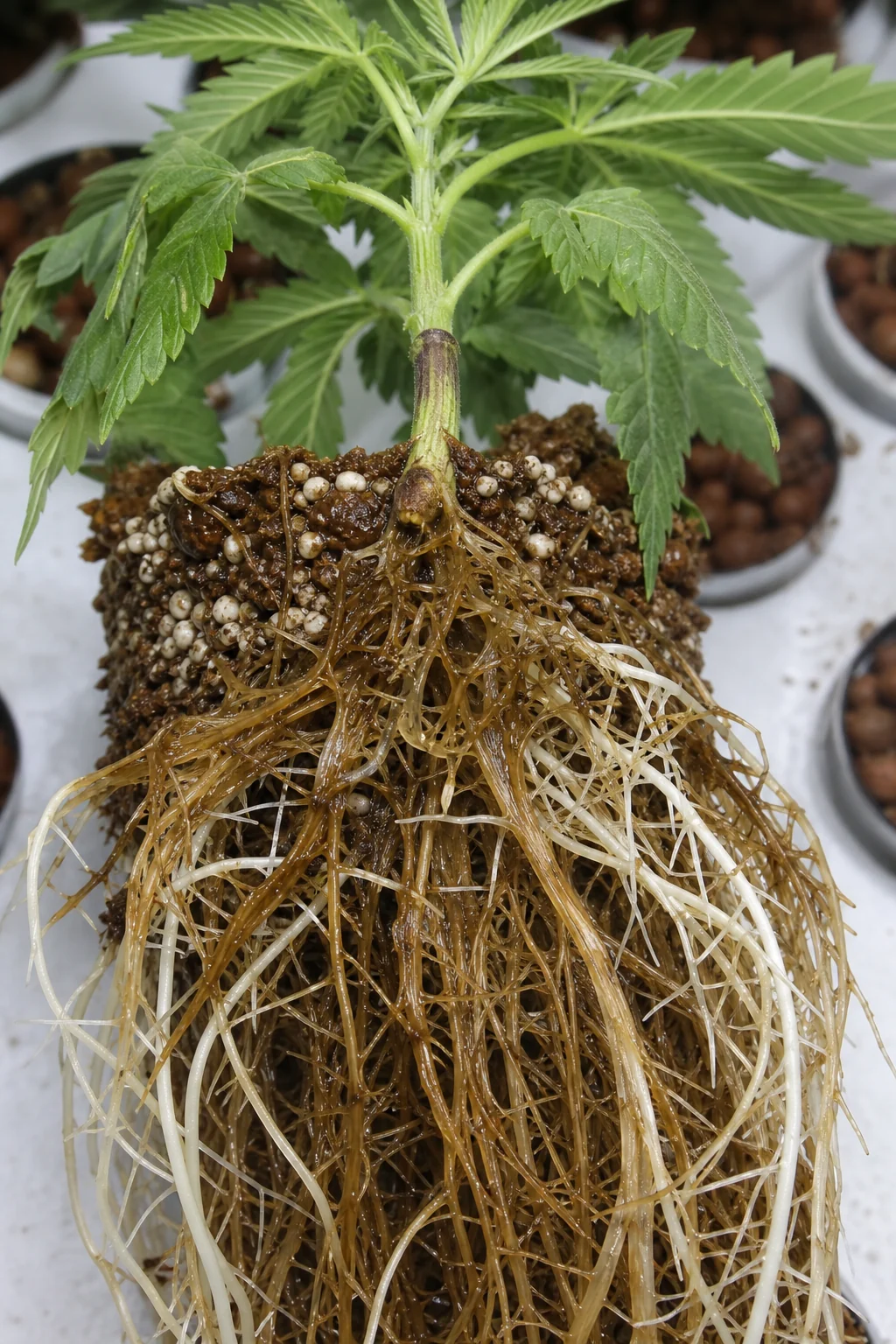
AI-generated educational reconstruction of Pythium-like root rot in cannabis roots
Example. Water-soaked tan to brown roots with weak cortex that may slough away, poor root tips, seedling damping-off or crown rot. Compare with firm bright-white healthy roots. Generated plate; not to scale and apparent magnification varies.OpenAI image generation
Earliest reliable signsPoor rooting, midday wilt despite wet media, yellowing, slow water uptake, stem-base collapse and linked symptoms along shared water circuits.
Life cycle and spreadOospores persist; sporangia and motile zoospores support waterborne spread. Warm root zones, low dissolved oxygen, saturation and biofilm can increase risk, but species differ.
Condition-qualified developmentMotile zoospores can infect susceptible root tips quickly and symptoms may progress over days in warm, oxygen-poor or saturated systems; species, crop age and root-zone conditions alter the course.
Size / inspection scalePlate is uncalibrated. Compare the whole root mass, individual root tips, cortex and crown against healthy white roots; confirm causal structures or organisms by diagnostic-laboratory microscopy, culture or molecular testing.
Where to inspectRoots, crown, drain water, tank/line biofilm, root-zone temperature, dissolved oxygen, irrigation frequency, standing water and linked hydro cohorts.
ConfirmationPlant diagnostic laboratory by microscopy, culture and/or molecular testing. Visual root colour alone is not a species diagnosis.
LookalikesAbiotic root death, hypoxia without infection, Fusarium, nutrient salt injury and normal old-root browning.
Internal thresholdAny damping-off cluster, crown rot or linked hydro pattern triggers isolation and water-system investigation.
First responseStop sharing water/material, remove collapsed plants, sample before sanitising, correct root-zone oxygen/moisture/temperature defects, clean biofilm under a validated SOP, and use only a lawful approved biological/input programme.
Layered control optionsCultural: start with clean stock/media and isolate affected water circuits. Environmental: correct saturation, heat, low dissolved oxygen, standing water and biofilm. Biological: use only a lawful preventive antagonist suited to the reservoir. Approved input: distinguish crop/root contact from validated line or surface sanitation.
Target stage and plant partTarget prevention at root tips, crowns and waterborne inoculum; sample before sanitation. Dead/sloughed roots require removal and system correction, not a curative promise.
Crop, worker, residue and compatibility constraintsAntagonists are incompatible with many sanitisers. Verify root-zone use, strain/product status, crop stage, worker PPE/REI, residue route, reservoir compatibility and discharge controls.
Specimen handlingCollect lesion-margin roots/crown, media and linked tank/return water before cleaning into separate sterile labelled containers; keep cool and preserve circuit/lot chain of custody.
Dated recheck and success criterionReinspect root tips/crowns and linked cohorts and repeat the validated water/root test after the approved interval; success is healthy new white roots, no new collapse and no linked spread.
Trace-back and CAPA triggerInvestigate propagation source, water circuit, temperature/DO, saturation/dryback, biofilm, hoses/trays, tools, staff and every connected cohort.

Profile evidence: [23][22][19]

4. Fusarium wilt, root and crown disease (Fusarium species complexes)
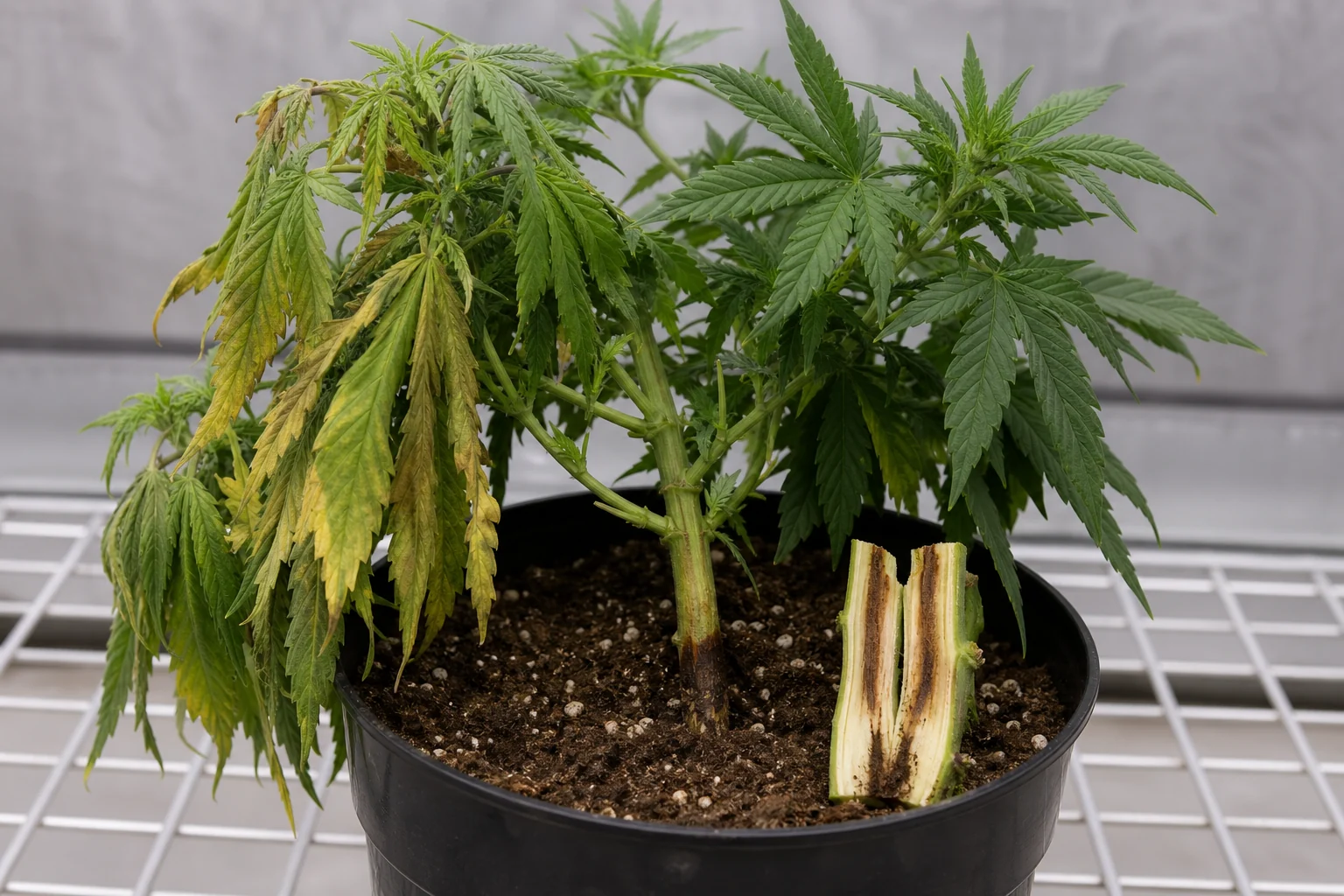
AI-generated educational reconstruction of Fusarium-like wilt and vascular browning in cannabis
Example. Progressive or one-sided wilt/yellowing with crown/root lesions and internal vascular browning in cut stem or crown tissue. Generated plate; not to scale and apparent magnification varies.OpenAI image generation
Earliest reliable signsWeak rooting, damping-off, stem-base lesions, chlorosis, wilt that does not recover normally, and cohort patterns linked to stock, tools, media or water.
Life cycle and spreadDifferent Fusarium species complexes can act as root, crown, vascular or flower pathogens. Conidia disperse with contaminated water, tissue and equipment; spores germinate at root tips or wounds, hyphae colonise xylem, and chlamydospores persist in plant/media debris.
Condition-qualified developmentRoot infection and vascular symptoms can develop over days to weeks; species complex, inoculum, temperature, moisture and plant stress determine the interval, while resting chlamydospores persist far longer.
Size / inspection scalePlate is uncalibrated. Assess whole-plant asymmetry, then inspect longitudinal crown/stem cuts and root-lesion margins; laboratory isolation and molecular identification provide the causal scale.
Where to inspectCut symptomatic crown/stem lengthwise, compare vascular tissue with a healthy plant, inspect roots, trace propagation source, tools, media lots and irrigation links.
ConfirmationDiagnostic laboratory isolation plus molecular identification where required. Management depends on the actual disease syndrome and source.
LookalikesPythium, drought/hypoxia, root mechanical injury, nutrient imbalance, HLVd-associated poor vigour.
Internal thresholdAny confirmed clean-stock or clonal-line case is high consequence; clustered production cases are systemic until trace-back proves otherwise.
First responseIsolate, bag and destroy as the site procedure directs; hold linked clones; sample before cleaning; investigate stock/tools/media/water; correct structural risk; do not promise a curative rescue for vascular infection.
Layered control optionsCultural: use tested stock, clean media/tools and destroy confirmed vascular cases. Environmental: correct root injury, saturation and heat without implying climate cures infection. Biological: use only a lawful preventive antagonist with strain-specific evidence. Approved input: distinguish preventive root use from line/surface sanitation.
Target stage and plant partPrevent root-tip/wound entry and conidial movement; vascular colonisation is not a credible curative target, so confirmed plants and linked source pathways drive the decision.
Crop, worker, residue and compatibility constraintsSpecies/syndrome confirmation matters. Antagonist-sanitiser incompatibility, crop stage, root-zone use, label PPE/REI, residue route and discharge controls must be resolved before inputs.
Specimen handlingCollect root/crown lesion margins and a longitudinal stem section including brown and healthy vascular tissue with clean tools; bag separately, keep cool and preserve stock/media/water links.
Dated recheck and success criterionInspect linked cohorts for new wilt and vascular browning and repeat laboratory testing on the approved schedule; success is no new cases after removal and correction, not recovery of infected vascular tissue.
Trace-back and CAPA triggerTrace mother/clone genealogy, seed or plant source, tools, media lots, water circuits, root injury, staff movement and every linked cohort or batch.

Profile evidence: [22][19]

5. Hop latent viroid disease (Hop latent viroid (HLVd))
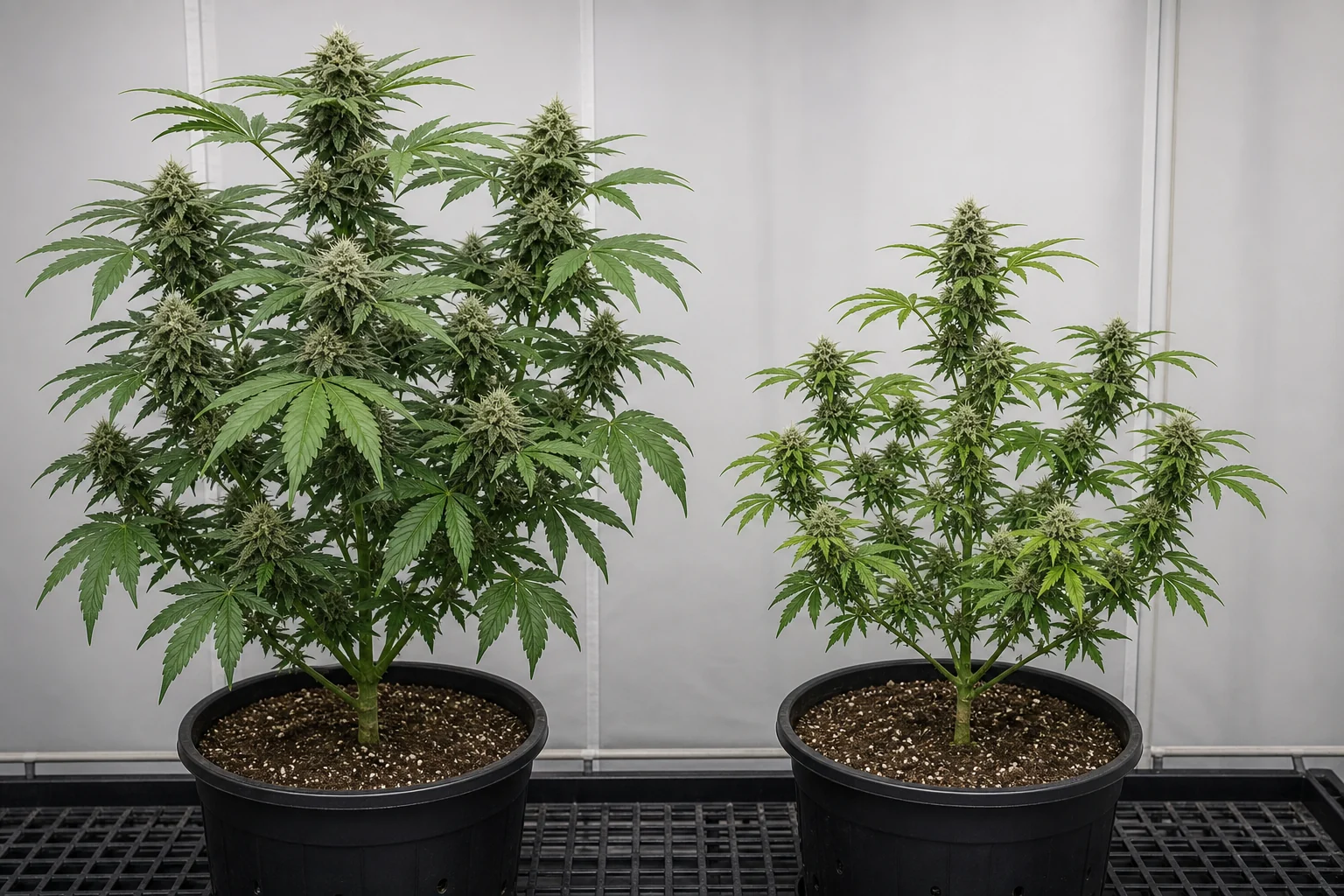
AI-generated educational comparison of healthy cannabis and nonspecific HLVd-like symptoms
Example. There is no reliable visual diagnosis. Plants may be asymptomatic or show shortened internodes, weak vigour, poor rooting, reduced trichomes and small low-quality flowers. Generated plate; not to scale and apparent magnification varies.OpenAI image generation
Earliest reliable signsA clonal line or linked hydro cohort underperforms without a clear environmental cause. Visual symptoms are nonspecific and absence of symptoms proves nothing.
Life cycle and spreadThe viroid moves with infected vegetative material and mechanically through contaminated tools; research also supports risk through roots and recirculated hydroponic solution.
Condition-qualified developmentThere is no dependable visual development window: infection may remain asymptomatic while moving through clonal lines. Surveillance timing must follow the validated molecular method and stock-risk schedule.
Size / inspection scalePlate is uncalibrated. Compare whole plants and clonal cohorts only to choose samples; confirmation operates at the traceable individual-plant or validated pool level by RT-qPCR/RT-PCR, not visual magnification.
Where to inspectUse traceable molecular surveillance in quarantine, foundation mothers and production mothers. Sampling tissue and timing must follow the validated laboratory method.
ConfirmationRT-qPCR or RT-PCR only, with appropriate controls and repeat/inconclusive rules. The generated plate is not diagnostic evidence.
LookalikesRoot disease, irrigation faults, nutrient imbalance, russet/broad mites, genetic low vigour and other systemic pathogens.
Internal thresholdZero tolerance in quarantine, foundation mothers, production mothers and clone-source material.
First responseQuarantine the plant and linked material; stop clone movement; confirm result; destroy positives under the approved SOP; hold daughters since the last verified negative; investigate tools, staff path and shared hydro systems; verify CAPA with follow-up testing.
Layered control optionsCultural: admit tested stock, segregate genealogy, sanitise tools between defined plant units and destroy confirmed positives. Environmental: segregate unvalidated recirculating solution; climate does not clear infection. Biological: no established curative role. Approved input: sanitisers apply only through a validated legal tool/surface process.
Target stage and plant partTarget exclusion and mechanical/root transmission pathways, not visible symptoms. Molecularly monitor quarantine, foundation and production mothers and trace every daughter lot.
Crop, worker, residue and compatibility constraintsNo image, vigour score or symptom absence releases stock. Sampling tissue/timing, controls, pooling, repeats and inconclusive rules follow the validated RT-qPCR/RT-PCR method; review sanitiser PPE/REI/residue use separately.
Specimen handlingCollect the validated tissue with single-use or decontaminated tools into the laboratory container; maintain accession, plant, mother, clone-lot, collector, time and temperature chain of custody.
Dated recheck and success criterionRepeat positives/inconclusives and test linked material under the approved method; success is documented destruction/containment plus verified negative surveillance of the defined trace cohort, never symptom improvement.
Trace-back and CAPA triggerTrace every daughter since the last verified negative, tool/staff path, sampling integrity, root contact and shared hydro circuits; hold affected lots until QA closes the investigation.

Profile evidence: [24][25][26]

6. Septoria leaf spot (Septoria cannabis, S. neocannabina, S. cannabicola and related diagnoses)
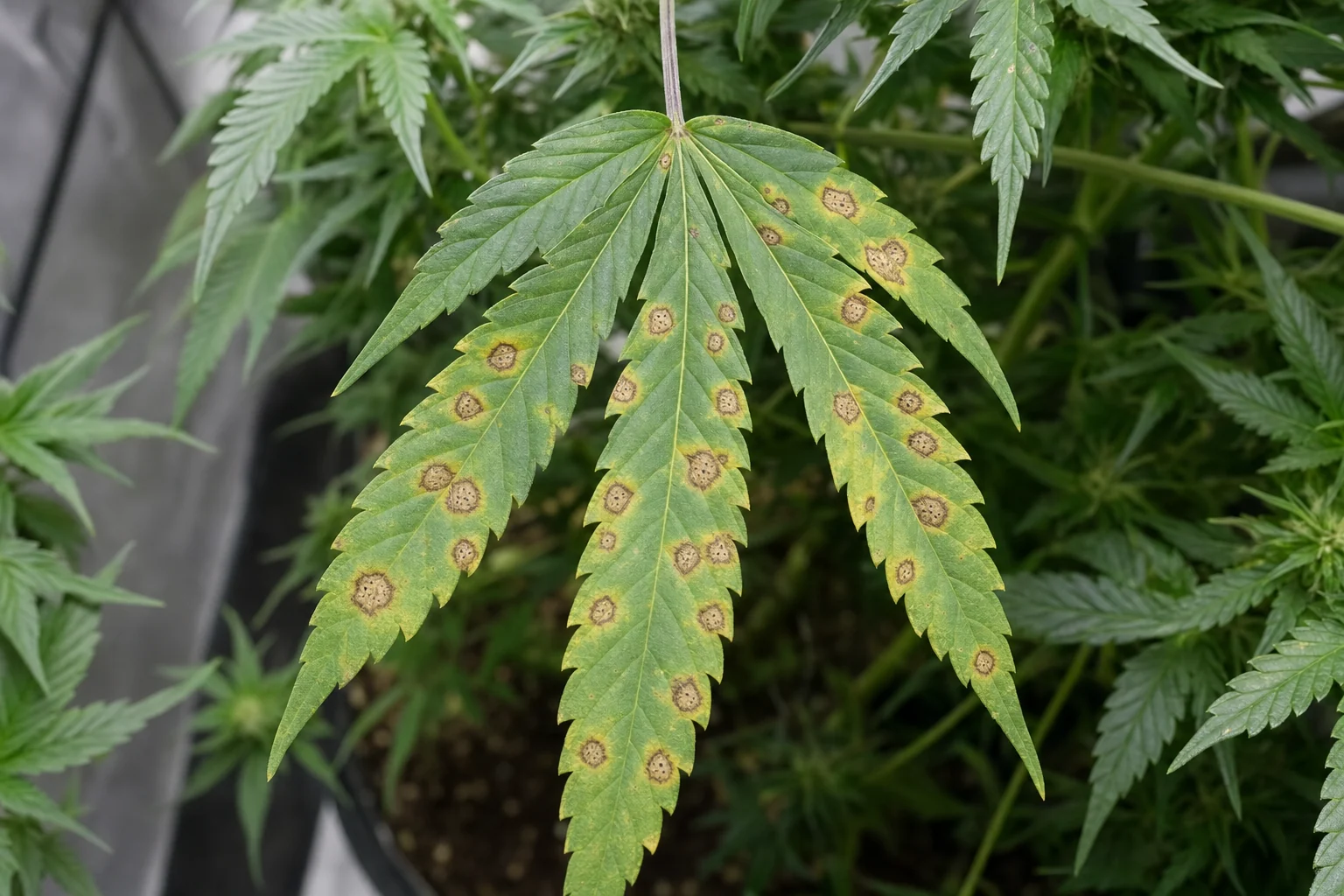
AI-generated educational reconstruction of Septoria-like leaf spot on a lower cannabis leaf
Example. Discrete tan, grey-brown or brown leaf lesions with chlorotic margins; tiny dark pycnidia may occur in lesion centres. Lesions can coalesce and drive lower-leaf loss. Generated plate; not to scale and apparent magnification varies.OpenAI image generation
Earliest reliable signsLower/older leaves commonly show first. Splash, wet foliage and infected debris support spread, although indoor importance is site-specific.
Life cycle and spreadSeptoria species produce pycnidia and conidia in lesions. Species names cannot be assigned safely from lesion appearance alone.
Condition-qualified developmentLesion and pycnidium development takes days to weeks depending on species, temperature and wetness duration; repeated splash-driven conidial cycles can continue while wet debris remains.
Size / inspection scalePlate is uncalibrated. Inspect the whole lower leaf and individual lesion centres at about 30x-60x for dark pycnidia; laboratory microscopy, culture or sequencing is required where species matters.
Where to inspectMap lower-leaf lesions, check for splash/leaf wetness and infected debris, photograph both leaf surfaces, and review spray/nutrient history.
ConfirmationPlant diagnostic laboratory by microscopy/culture and sequence-based methods where species matters.
LookalikesNutrient deficiency, chemical splash, Cercospora/Bipolaris and other leaf spots, mechanical injury and senescence.
Internal thresholdAny confirmed quarantine/stock case triggers exclusion. In production, repeated lesions or a spreading pattern triggers containment and lab work.
First responseRemove infected debris into bags, prevent splash and leaf wetness, improve airflow, stop cross-room movement of wet tools/PPE, confirm diagnosis, and use only a lawful evidence-supported measure if intervention is justified.
Layered control optionsCultural: exclude infected stock, bag lesions/debris and prevent wet-tool movement. Environmental: stop splash and prolonged leaf wetness and improve lower-canopy airflow. Biological: use only a lawful antagonist supported for the confirmed diagnosis. Approved input: choose a legal crop-contact option only after laboratory and indoor-relevance review.
Target stage and plant partTarget infected lower leaves, debris and splash pathways before lesions coalesce; protect new foliage rather than expecting necrotic lesions to recover.
Crop, worker, residue and compatibility constraintsIndoor importance and species identity are site-specific. Flower contact, crop stage, beneficial compatibility, label PPE/REI, residues, phytotoxicity and spray-injury lookalikes constrain treatment.
Specimen handlingPhotograph both surfaces and collect several dry lesion-margin leaves with pycnidia plus a healthy comparator in separate labelled paper or laboratory-approved packaging; preserve spray/nutrient history.
Dated recheck and success criterionMap and recount new lesions on lower and newly exposed leaves after the approved interval and following any wetness event; success is no new lesions or upward spread through the defined observation window.
Trace-back and CAPA triggerInvestigate incoming stock, infected debris, overhead splash/irrigation, condensation/leaf wetness, tools/PPE, nutrient or chemical injury and linked rooms.

Profile evidence: [27][28][19]

11 · Diagnostic controls

Healthy references and the lookalikes that waste treatments

A diagnostic atlas without healthy controls trains people to see disease everywhere. Compare like with like: underside to underside, opened flower to opened flower, new meristem to new meristem, and roots at the same age and substrate.
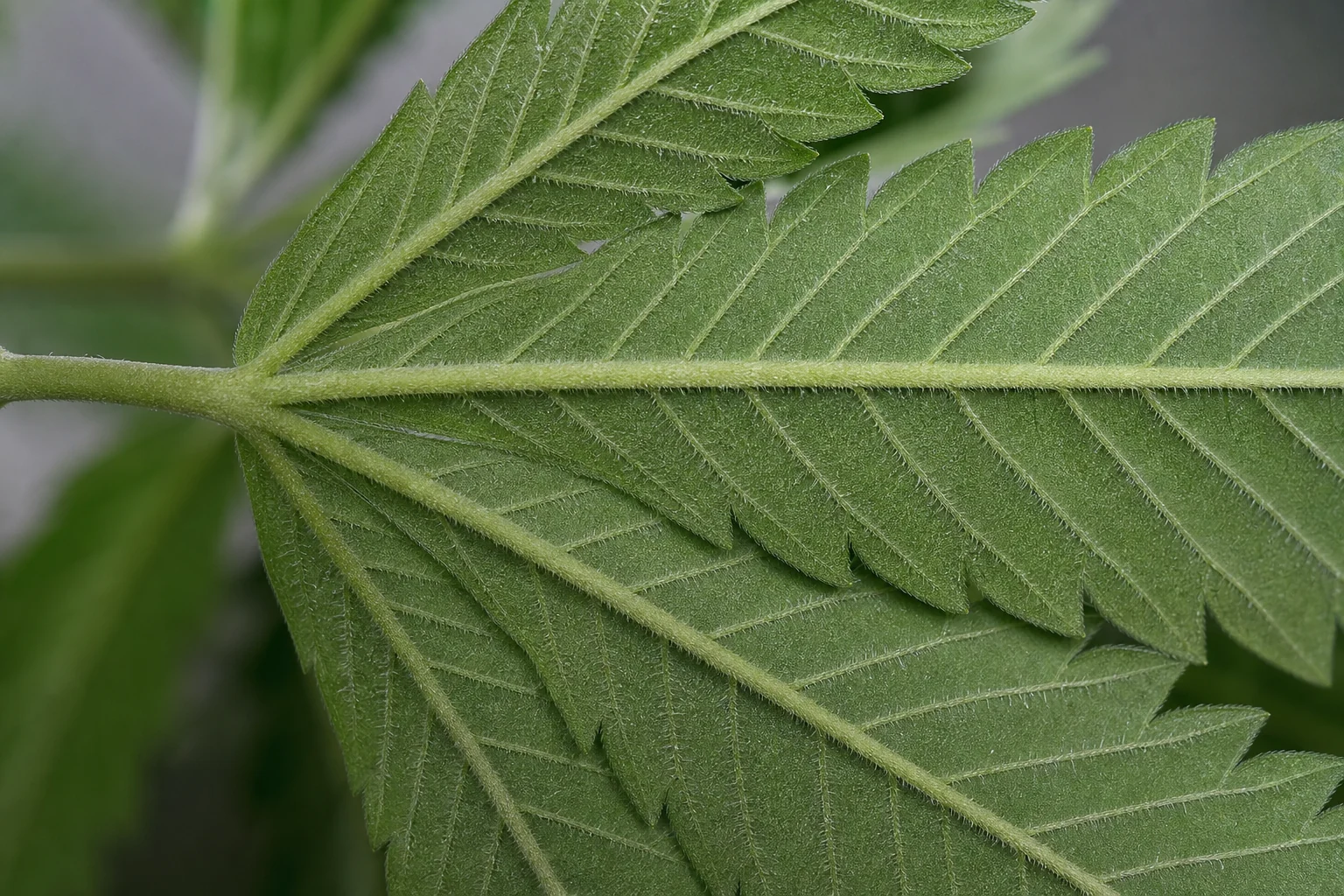
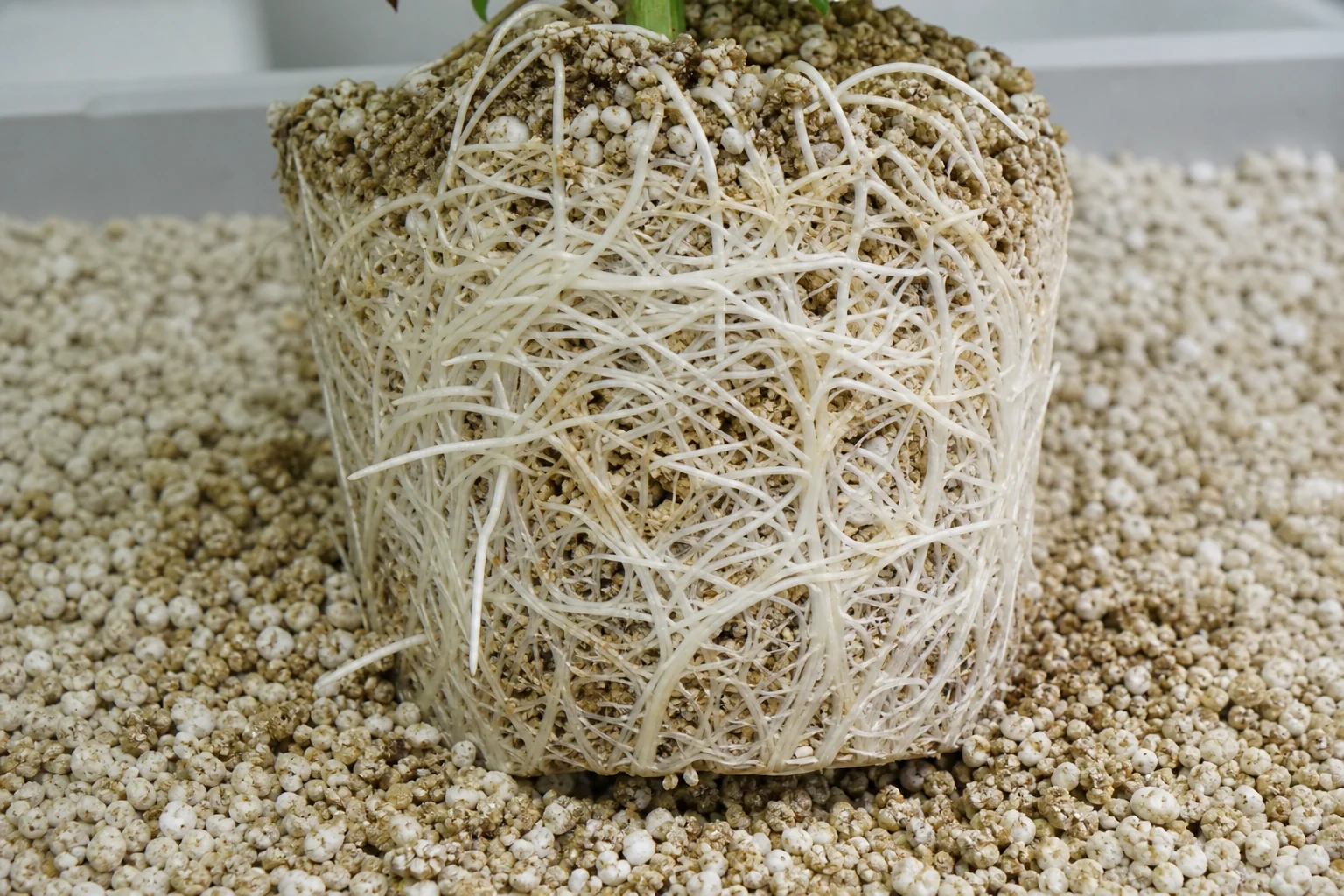
Key terms, in the facilityOpenAI image generation
Healthy leaf underside
Healthy white roots
Healthy white roots
Healthy shoot meristem
Healthy flower interior
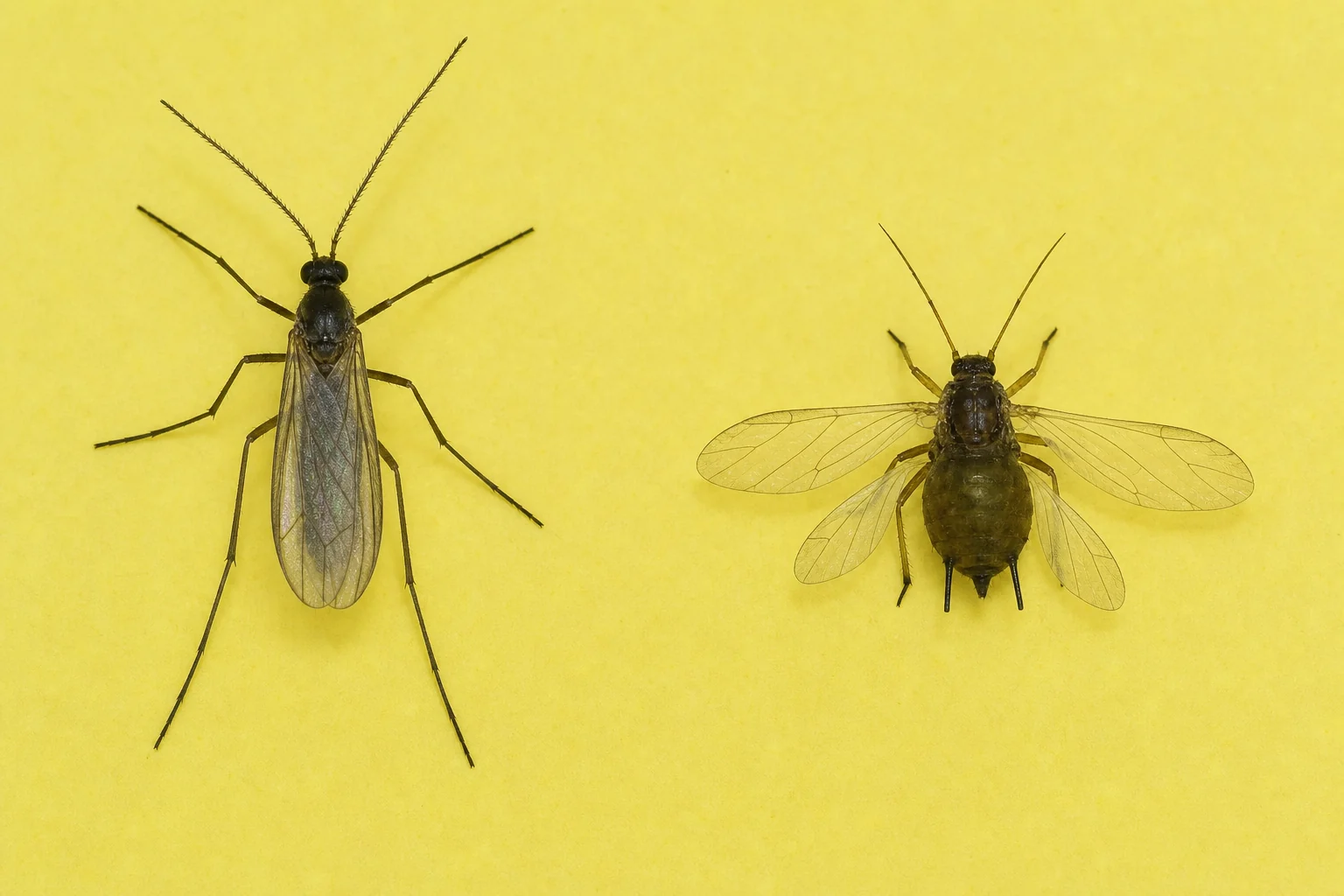
Fungus gnat vs winged root aphid
Heat/light tacoing without mites
Dried foliar residue, not mildew
Abiotic root stress, not a diagnosis
The generated comparison plates are training aids, not reference specimens.
ConfusionSeparating featureNext step
Fungus gnat adult vs winged root aphidGnat has fly-like legs/antennae and wing venation; aphid has pear-shaped body and corniclesPreserve low-card specimen and use microscopy
Broad/russet mites vs heat/light tacoingMites/eggs on sampled leading edge; abiotic stress follows exposure pattern without organismsMicroscope multiple tips before changing feed or climate
Powdery mildew vs dried foliar residuePM forms raised growing colonies and fungal structures; residue follows droplets/rings and spray historyAngled light, microscopy or lab if flower disposition depends on it
Pythium vs abiotic root stressWater-soaked sloughing and linked disease pattern vs dry/tan stressed roots without pathogen proofSample roots/water before sanitation and send to a diagnostic lab
HLVd vs everything that stuntsNo visual feature is confirmatoryRT-qPCR/RT-PCR with traceable sample and controls
12 · Runtime

Turn findings into a controlled weekly programme

  1. 1
    Score consequence
    Room class, clean-stock status, target organism, crop stage and product-quality consequence.
  2. 2
    Measure pressure
    Incidence, severity 0-4, life stages, spatial pattern, trap/root/lab trend and beneficial density.
  3. 3
    Apply override
    Zero-tolerance findings bypass a numeric threshold and move directly to containment.
  4. 4
    Find the source
    Incoming stock, staff/tool movement, air, water, media, packaging, weeds/algae or crop carryover.
  5. 5
    Select layers
    Cultural and environmental correction, then compatible biological and lawful input options.
  6. 6
    Schedule
    Target life stage, application/release date, room controls, mode rotation, recheck date and stop/escalate rule.
  7. 7
    Verify
    Measure live organisms/new lesions/new growth, establishment, injury, residue implication and recurrence.
  8. 8
    Close or CAPA
    Close only when the success criterion is met; otherwise revise cause and escalate.
The weekly meeting produces room-specific actions, not a narrative report nobody uses.
Weekly meeting inputDecision output
Trap and scouting trendsRoom/zone action, owner and recheck
HLVd/pathogen resultsRelease, hold, repeat, destroy and trace decision
Beneficial receipt/release/establishmentContinue, supplement, replace or investigate incompatibility
Environmental and root-zone excursionsEngineering/cultural correction with due date
Input applications and treated-area statusREI release, efficacy check and residue review
Open CAPA and linked batchesContainment status, evidence gap, quality disposition and effectiveness check

Control-strategy decision worksheet

Complete against the current approved-input and beneficial registers; product names and rates do not belong in an uncontrolled paper.
Decision fieldControlled entry
Confirmed target, life stage and plant partFACILITY INPUT
Current pressure: incidence, severity, trend and distributionFACILITY INPUT
Source/pathway hypothesis and evidenceFACILITY INPUT
Cultural and environmental correctionsFACILITY INPUT
Biological option, establishment evidence and compatibilityFACILITY INPUT
Input option, legal gate, mode group and residue routeFACILITY INPUT
Crop/worker constraints, REI and treated-area releaseFACILITY INPUT
Owner, action date, recheck date, success and stop/escalate ruleFACILITY INPUT

Dated intervention and beneficial-release planner

Use enough rows to cover the target's condition-dependent development window; revise after each recheck.
Date/timeRoom/zoneTarget stageAction or releaseMode / organismCompatibility and REIRecheck
FACILITY INPUTFACILITY INPUTFACILITY INPUTFACILITY INPUTFACILITY INPUTFACILITY INPUTFACILITY INPUT

Target-by-approved-tool matrix

A planning interface to the controlled registers, not a substitute for them.
TargetCurrently approved toolTarget stage/siteEvidence grade/sourceLegal verification dateCompatibilitySuccess measure
FACILITY INPUTFACILITY INPUTFACILITY INPUTFACILITY INPUTFACILITY INPUTFACILITY INPUTFACILITY INPUT
Finding to closure1Confirmorganism, lifestage, location2Containmovement,plants, water,treated area3Controllayered lawfulplan4Recheckdefined evidenceand date5Close / CAPAcriterion met orroot causerevised
Figure 6. The minimum operational record for every threshold-triggering event.
13 · Crop cycle

Operate from receiving through release, not room by room in isolation

A complete crop-cycle control model. Exact timing follows cultivar, facility and approved production plan.
StageDaily standard workWeekly / scheduled workHard decision
Receiving / quarantineAccession, source/legal check, visual/root inspection, dedicated tools and wasteTraps, HLVd/pathogen plan, reassessmentPromote only when legal and biological release criteria are met
Foundation / production mothersHealth walk, tool control, irrigation and environmentMolecular schedule, full scout, pruning-hygiene auditPositive HLVd or systemic/high-consequence pest = stop, hold, trace
Cuttings / rootingSanitary cutting, humidity/airflow, dead cutting and root reviewRoot development, traps, fungus/root-disease checkPatterned failure triggers source, water and diagnostic investigation
VegetativeEnvironment/root-zone review and visible pest walkFull scout, cards, biological release/establishmentSingle high-risk hotspot or rising trend triggers targeted action
FlowerClimate/dew-point/air movement and dense-canopy inspectionFull scout, late-flower destructive bud checks by risk, residue/use reviewAny PM on flowers or Botrytis in a bud is immediate action
Harvest / dry / holdHygienic handling, waste segregation, dry-room condition and mould checksResidue/microbial/foreign-matter sampling and deviation reviewRelease, continue hold, remediate if lawful/validated, or reject
Post-harvest is still IPM

Contaminated tools, slow or uneven drying, dense uninspected flowers and dirty processing equipment can erase a clean cultivation run. Product remains on hold until the required quality evidence and deviation review are complete.

14 · Quality system

Contain the crop, then investigate the system

Classify events as local, room-wide or systemic. Containment comes first; root cause and batch impact follow while evidence is preserved. CAPA is incomplete until the effectiveness check proves the change worked.

CAPA joins biological cause, worker/system cause and product-quality consequence.
EventImmediate containmentBatch/crop assessmentCAPA focus
HLVd-positive motherStop clone movement, isolate/bag under SOP, hold linked daughtersAll daughter lots since last verified negative plus connected tools/waterSource, test cadence, sample integrity, tool sanitation, hydro segregation and traceability
Powdery mildew on flowerIsolate zone/room, bag affected tissue, intensify scoutingExtent, crop stage, lawful options, residue and market dispositionNight microclimate, density, airflow, scouting sensitivity and programme compatibility
Botrytis inside flowerControlled removal without spore spread, inspect neighboursLot hold/extent, cultivar/zone pattern, environmental historyHumidity removal, condensation, flower architecture, handling injury and debris
Root disease linked to shared waterIsolate circuit, stop transfer, sample before sanitationAll connected cohorts and source stockReservoir/return design, biofilm, temperature/DO, cleaning validation and water segregation
Worker enters during REIRemove worker, exposure response, secure area/signageAssess crop contact/contamination and treatment statusLockout, sign placement, training, supervision and access control
  1. Release: required analytical results, treatment history, traceability and deviation review are satisfactory.
  2. Continue hold: result, investigation, repeat sample or linked-lot status is incomplete.
  3. Reject or validated remediation: the lot fails a limit, has an indefensible treatment history, or is linked to a systemic contamination failure. Remediation is not a substitute for prevention.
15 · Working tools

The forms must make the right action easier than the shortcut

Facility approval sheet

Weekly scouting record

Use one row/set per mapped site or exception. Unknown organisms receive a specimen/photo reference, not a guessed name.
Required fieldEntry
Date/time, scout, room, zone, bench and fixed route pointFACILITY INPUT
Plant/lot ID and growth stageFACILITY INPUT
Leaf top, underside, meristem, stem/crown, flower, media and roots checkedFACILITY INPUT
Trap ID, colour, height, deploy/replace date and counts by organismFACILITY INPUT
Confirmed organism, life stage, incidence and severity 0-4FACILITY INPUT
Beneficial organism and establishment evidenceFACILITY INPUT
Environmental/root-zone anomaly and recent interventionFACILITY INPUT
Photo ID, specimen ID, chain of custody and lab resultFACILITY INPUT
Threshold status, containment, owner and due dateFACILITY INPUT
Recheck date, success criterion and close/CAPA decisionFACILITY INPUT
Planned sites, completed sites and missed/inaccessible-site exceptionFACILITY INPUT

Quarantine and clean-to-dirty movement log

Record every accession transfer and every authorised backtrack across the hygiene gradient.
Date/timePerson or materialFromToRelease/status evidencePPE/tool changeException approval
FACILITY INPUTFACILITY INPUTFACILITY INPUTFACILITY INPUTFACILITY INPUTFACILITY INPUTFACILITY INPUT

Beneficial release and establishment record

FieldEntry
Species/strain, supplier and lotFACILITY INPUT
NZ legal-status evidence and approval dateFACILITY INPUT
Arrival time, temperature and conditionFACILITY INPUT
Viability/count check and rejection decisionFACILITY INPUT
Target pest/stage, room map and release rateFACILITY INPUT
Climate and incompatible residue reviewFACILITY INPUT
Establishment/recheck date and evidenceFACILITY INPUT
Corrective action or close-outFACILITY INPUT

Spray / application quality checklist

CheckControlled entry
Event ID; approved product/lot; target; room/zone; crop stageFACILITY INPUT
Current label/SDS, medicinal-cannabis, ACVM and HSNO evidence checkedFACILITY INPUT
Applicator, calibration, output, nozzle/pressure and target coverageFACILITY INPUT
Water quality, mixing order, agitation and prepared volumeFACILITY INPUT
HVAC/lights controls, containment, weather/external-discharge riskFACILITY INPUT
PPE, signage, access control, REI start/end and treated-area releaseFACILITY INPUT
Unused mix, rinse, spill/waste disposition and equipment clean-downFACILITY INPUT
Phytotoxicity, efficacy and residue recheck dates / resultsFACILITY INPUT

Outbreak, batch-impact and CAPA record

FieldEntry
Event ID, first detection and detectorFACILITY INPUT
Confirmed organism / evidence / uncertaintyFACILITY INPUT
Room, zone, plants, mothers, clone lots and batchesFACILITY INPUT
Linked staff, tools, air, water, media and input lotsFACILITY INPUT
Immediate containment and treated-area controlsFACILITY INPUT
Product-quality and residue impact assessmentFACILITY INPUT
Hold, destruction, remediation or release decisionFACILITY INPUT
Root cause and contributing conditionsFACILITY INPUT
Corrective and preventive actions, owners and datesFACILITY INPUT
Effectiveness evidence and quality close-outFACILITY INPUT

Population-trend dashboard worksheet

Graph or trend these same controlled fields in the site's validated record system; record denominator and missed sites so the line means something.
Week/dateRoom/zoneTargetTrap or sampled unitsLive count / incidenceSeverity 0-4Beneficial densityAction lineDecision
FACILITY INPUTFACILITY INPUTFACILITY INPUTFACILITY INPUTFACILITY INPUTFACILITY INPUTFACILITY INPUTFACILITY INPUTFACILITY INPUT

Spill and waste control

  • Current drain map distinguishes sanitary sewer/trade waste from stormwater.
  • Secondary containment and spill kits match the stored substances and credible spill volume.
  • No pesticide, sanitiser, nutrient concentrate, contaminated rinse water or spill enters stormwater.
  • Watercare and Auckland pollution-response triggers are posted and trained.
  • Waste contractors and disposal records are current; annual drill findings enter CAPA.
16 · Competency

Attendance is not competence

WorkSafe requires site-specific information, instruction, training and records; a prior course does not remove the site's duty[7].
ModuleAudienceDemonstrated outcome
NZ medicinal-cannabis input gateQA, procurement, IPM/cultivation leadsReject or approve a candidate input with the correct evidence trail
Hygiene zoning and movementAll cultivation, sanitation, maintenance and contractorsExecute room order, tool/PPE changes and exception process
Scouting and specimen handlingScouts and room leadsFollow fixed route, identify plant parts, record incidence/severity, preserve unknown
Mother stock and HLVdNursery, mother and QA staffCollect traceable sample, place hold, trace daughters and execute positive response
Beneficial controlIPM team and receivingVerify delivery, viability, release map, compatibility and establishment
Application, REI and PPEApplicators, supervisors, QA/EHSCalibrate, mix, apply, contain waste, post signs and release treated area
CAPA and batch impactQA, cultivation management, IPM leadRun mock event from containment through effectiveness check
Drill the ugly events

Run at least: HLVd-positive mother, Botrytis cluster in late flower, root disease on a shared circuit, unlawful input discovered after application, REI entry breach and a spill threatening a drain. A plan only earns trust after someone has tried to use it under pressure.

17 · Reference

Glossary

The biological, diagnostic, operational and New Zealand regulatory terms used in this blueprint.

Action thresholdThe pre-approved point at which observation becomes intervention. It may be a count, a trend, a severity level or a zero-tolerance finding.
AlateA winged aphid produced for dispersal.
AntagonistA beneficial microorganism that suppresses a plant pathogen by competition, antibiosis or other interaction.
AsexualReproduction without fusion of gametes; many indoor pest and pathogen populations multiply mainly through asexual stages.
AxilThe angle where a leaf or branch joins the stem, often a protected inspection point.
BiosecurityControls that prevent pests and pathogens entering or moving through the facility.
BronzingBronze-brown discolouration caused by feeding injury or stress; it is a symptom, not an organism diagnosis.
CAPACorrective and preventive action: contain the event, find the cause, fix it, prevent recurrence and verify effectiveness.
ChlorosisLoss of green colour from tissue.
Conidium / conidiaAn asexual fungal spore / spores used for dispersal.
CornicleOne of the paired tube-like structures near the rear of an aphid.
Crown rotDisease at the junction of stem and root system.
Cupping / tacoingUpward or downward leaf-edge curvature associated with heat, humidity, chemical injury or mite feeding; inspect for organisms before assigning cause.
Damping-offSeedling or cutting collapse caused by root/crown pathogens, commonly including Pythium or Fusarium.
Dew-point marginThe gap between tissue/surface temperature and dew point. A small gap means condensation risk.
Dissolved oxygenOxygen dissolved in irrigation solution; low levels can stress roots and favour some root-disease conditions.
DuddingA nonspecific production term for weak, stunted cannabis with poor flower development; it does not diagnose HLVd.
EntomopathogenicAble to infect and kill insects or mites.
ExclusionMeasures that prevent a pest, pathogen or unapproved material entering the controlled crop system.
FRAC / IRACFungicide and insecticide resistance-action classification systems used to rotate modes of action.
HoneydewSticky sugar-rich excretion from aphids, whiteflies and related sap feeders.
IncidenceThe proportion of plants or sites affected, separate from how badly each is affected.
InoculumPathogen material capable of starting infection, such as spores or infected debris.
InstarA growth stage between moults in an immature arthropod.
LarvaA feeding immature stage that differs from the adult; fungus gnats, thrips and caterpillars have diagnostically important larval stages.
LOQLimit of quantification: the lowest level a method can measure with acceptable performance.
MeristemThe actively dividing shoot-tip tissue that produces new growth.
MyceliumThe network of fungal hyphae that forms the growing body of a fungus.
Mould / moldVisible fungal growth; mould is the standard New Zealand spelling, while mold may appear in imported references.
NecrosisDead plant tissue.
NymphAn immature arthropod stage that broadly resembles the adult but is not yet mature.
OomyceteA fungus-like organism; Pythium is an oomycete, not a true fungus.
OosporeA thick-walled survival spore produced by some oomycetes.
ParasiteAn organism that lives in or on a host and draws resources from it, usually without the one-host lethal outcome that defines a parasitoid.
ParasitoidAn organism, usually a wasp in IPM, whose immature stage develops in or on one host and kills it.
ParthenogenesisProduction of offspring without fertilisation; it enables rapid population growth in several indoor pests.
PathogenAn organism or agent that causes disease.
PetioleThe stalk joining a leaf blade to the stem and a useful inspection site for mites and symptoms.
Preventive / curativeApplied before establishment to prevent pressure / applied after confirmation to reduce an active problem.
PredatorA beneficial organism that consumes multiple prey during its life.
PupaA generally non-feeding stage between larva and adult in complete metamorphosis; it may be protected in media or debris.
PycnidiumA small flask-like fungal fruiting body that produces conidia; it may appear as a dark dot in a Septoria lesion.
REIRestricted entry interval: the period when entry is prohibited unless specified PPE and conditions are met.
ReleaseA documented quality decision allowing a held plant, material or batch to move or be supplied after defined evidence and approvals are complete.
Residue limitThe applicable maximum or action limit used for analytical disposition; its presence does not authorise pesticide use.
Rogue / roguingRemove and destroy a diseased or infested plant from the production system.
RussetingBronze-brown roughened tissue associated with feeding injury or other stress.
SeverityHow much of a plant/site is affected, distinct from incidence.
SachetA small carrier pack that releases beneficial organisms into the crop over time under defined conditions.
SanitationValidated cleaning and, where required, disinfection that removes debris and reduces viable contamination on a defined surface or system.
ScoutingA repeatable, mapped inspection and sampling process used to detect, identify, quantify and trend crop-health findings.
Sooty mouldDark fungus growing on honeydew; it is a sign of sap-feeding insects, not usually the primary plant pathogen.
SprenchAn application volume between a spray and drench intended to reach the plant base/media surface.
SporeA fungal or fungus-like reproductive or survival unit; its type and biology determine sampling and control.
StipplingMany tiny pale feeding points caused when mites or other pests empty plant cells.
Systemic resistanceA plant-wide defensive state induced by a stimulus; it may reduce susceptibility but does not prove control of an established pathogen.
VectorA living or mechanical carrier that moves a pest or pathogen.
ViroidA small infectious RNA molecule without a protein coat; HLVd is a viroid.
ZoosporeA motile waterborne spore produced by oomycetes such as Pythium.
ACVMNew Zealand agricultural compounds and veterinary medicines regulatory framework administered by MPI.
EPANew Zealand Environmental Protection Authority, which administers hazardous-substance and new-organism approvals and controls.
HSNOHazardous Substances and New Organisms Act framework administered by the EPA.
Inhalation / non-inhalation lineThe intended medicinal-cannabis end-use pathway that changes which pesticide-active provisions and quality consequences apply; it must be set before input selection.
MPINew Zealand Ministry for Primary Industries, including administration of ACVM and biosecurity pathways relevant to inputs and organisms.
Minimum quality standardThe statutory quality requirements medicinal-cannabis ingredients and products must meet before supply in New Zealand.
Approved-input registerThe site's controlled list of products and organisms that passed legal, safety, analytical, compatibility and operational review.
Batch holdA quality status that prevents movement or release while evidence or investigation is incomplete.
Trade wasteCommercial or industrial liquid waste discharged to the wastewater network under Watercare/Auckland controls.
18 · Governance

Evidence and revision register

This blueprint is controlled guidance, not a frozen truth. Review the volatile parts before the static prose.
Claim classMinimum evidenceReview trigger
NZ legal / regulatoryCurrent official Ministry, MPI, EPA, WorkSafe, Watercare or Auckland sourceAny law/guidance revision, new product/organism, annual review
Pest/disease biologyPrimary paper or strong technical review; species caveatNew diagnostic result, organism not behaving as assumed
Product/organism statusCurrent register/approval, label, SDS, supplier and site approvalEvery purchase/use and any document revision
Facility thresholdSite history, risk rationale and quality approvalTrend miss, crop loss, false alarm, process or market change
Operational setpointNamed facility SOP/validation and measured dataEquipment, cultivar, room, substrate or process change
Generated imageFinal prompt, generation tool, human diagnostic review and disclosureMorphology error, confusion in training or better verified reference
Implementation judgement

The resilient programme is the one that keeps unlawful inputs out, infected genetics out, water and air from becoming transport systems, staff movement legible, and release logic visible at the moment a control is chosen. Everything else is decoration.

Related papers

References

  1. New Zealand Ministry of Health. Pesticide use during cultivation of medicinal cannabis. Guidance under the Misuse of Drugs (Medicinal Cannabis) Regulations 2019; updated guidance effective from July 2024. (industry/manufacturer or non-journal source) https://www.health.govt.nz/regulation-legislation/medicinal-cannabis/information-for-industry/pesticide-use-during-cultivation
  2. New Zealand Ministry of Health. Requirements for the medicinal cannabis minimum quality standard. Testing, validation, laboratory and pesticide requirements; page current in 2026. (industry/manufacturer or non-journal source) https://www.health.govt.nz/regulation-legislation/medicinal-cannabis/information-for-industry/working-with-medicinal-cannabis/requirements-for-the-minimum-quality-standard
  3. New Zealand Ministry for Primary Industries. ACVMs exempt from registration: exemption classes, conditions and obligations under other legislation. (industry/manufacturer or non-journal source) https://www.mpi.govt.nz/agriculture/agricultural-compounds-vet-medicines/acvms-exempt-from-registration
  4. New Zealand Ministry for Primary Industries. Steps to importing invertebrates: eligibility, import health standards, facilities, permits and EPA status determination. (industry/manufacturer or non-journal source) https://www.mpi.govt.nz/import/importing-live-animals/invertebrates/steps-to-importing-invertebrates
  5. New Zealand Environmental Protection Authority. What hazardous-substance approvals are and how to find an approval, including SDS section 15 and current controls. (industry/manufacturer or non-journal source) https://www.epa.govt.nz/hazardous-substances/substance-approvals-and-group-standards/what-approvals-are-and-how-to-find-one-for-your-product/
  6. WorkSafe New Zealand. Restricted entry intervals for pesticides - quick guide: labels/SDS, off-label risk assessment, indoor signs, access and PPE. (industry/manufacturer or non-journal source) https://www.worksafe.govt.nz/topic-and-industry/hazardous-substances/regulations/restricted-entry-intervals-for-pesticides/restricted-entry-intervals-for-pesticides-quick-guide/
  7. WorkSafe New Zealand. Information, instruction, supervision and training for workers handling hazardous substances. (industry/manufacturer or non-journal source) https://www.worksafe.govt.nz/topic-and-industry/hazardous-substances/managing/information-instruction-supervision-training/
  8. Watercare. Trade waste agreements: classification, controls, monitoring and management-plan requirements for Auckland businesses. (industry/manufacturer or non-journal source) https://www.watercare.co.nz/business/help-and-support/trade-waste/trade-waste-agreements
  9. Auckland Council. Auckland Unitary Plan Operative in Part, E33 Industrial and trade activities: contaminant avoidance, onsite management, containment and lawful disposal. (industry/manufacturer or non-journal source) https://unitaryplan.aucklandcouncil.govt.nz/Images/Auckland%20Unitary%20Plan%20Operative/Chapter%20E%20Auckland-wide/5.%20Environmental%20Risk/E33%20Industrial%20and%20trade%20activities.pdf
  10. Athena Ag, Inc. (2026). IPM Guide for Cannabis, V15 digital edition. Commercial vendor guide supplied by the user; used only as a coverage benchmark. (industry/manufacturer or non-journal source)
  11. Ahmed, M. Z., McKenzie, C. L., & Osborne, L. S. (2024). Arthropod and mollusk pests of hemp, Cannabis sativa (Rosales: Cannabaceae), and their indoor management plan in Florida. Journal of Integrated Pest Management, 15(1), 1. https://doi.org/10.1093/jipm/pmad028
  12. Pulkoski, M. A., & Burrack, H. J. (2023). Assessing the impact of piercing-sucking pests on greenhouse-grown industrial hemp (Cannabis sativa L.). Environmental Entomology, 53(1), 1-10. https://doi.org/10.1093/ee/nvad044
  13. Cranshaw, W., Halbert, S. E., Favret, C., Britt, K., & Miller, G. L. (2018). Phorodon cannabis Passerini (Hemiptera: Aphididae), a newly recognized pest in North America found on industrial hemp. Insecta Mundi, 0662, 1-12. https://digitalcommons.unl.edu/insectamundi/1162/
  14. Cranshaw, W., & Wainwright-Evans, S. (2020). Cannabis sativa as a host of rice root aphid (Hemiptera: Aphididae) in North America. Journal of Integrated Pest Management, 11(1), 15. https://doi.org/10.1093/jipm/pmaa008
  15. Lopez, L. (2023). Meet Amblyseius swirskii (Acari: Phytoseiidae): a commonly used predatory mite in vegetable crops. Journal of Integrated Pest Management, 14(1), 20. https://doi.org/10.1093/jipm/pmad018
  16. van Maanen, R., Vila, E., Sabelis, M. W., & Janssen, A. (2010). Biological control of broad mites (Polyphagotarsonemus latus) with the generalist predator Amblyseius swirskii. Experimental and Applied Acarology, 52(1), 29-34. https://doi.org/10.1007/s10493-010-9343-2
  17. Cloyd, R. A. (2015). Ecology of fungus gnats (Bradysia spp.) in greenhouse production systems associated with disease-interactions and alternative management strategies. Insects, 6(2), 325-332. https://doi.org/10.3390/insects6020325
  18. Effects of Selected Biopesticides on Two Arthropod Pests of Cannabis sativa L. in Northeastern Oregon. (2024). Crops, 4(4), 19. https://doi.org/10.3390/crops4040019
  19. Punja, Z. K. (2021). Emerging diseases of Cannabis sativa and sustainable management. Pest Management Science, 77(9), 3857-3870. https://doi.org/10.1002/ps.6307
  20. Scott, C., & Punja, Z. K. (2021). Evaluation of disease management approaches for powdery mildew on Cannabis sativa L. (marijuana) plants. Canadian Journal of Plant Pathology, 43(3), 394-412. https://doi.org/10.1080/07060661.2020.1836026
  21. Mahmoud M, BenRejeb I, Punja ZK, Buirs L, Jabaji S. Understanding bud rot development, caused by Botrytis cinerea, on cannabis (Cannabis sativa L.) plants grown under greenhouse conditions. Botany. 2023;101(4):200-231. https://doi.org/10.1139/cjb-2022-0139
  22. Punja, Z.K., Tirajoh, A., Collyer, D., & Ni, L. (2023). Biological control of Fusarium oxysporum causing damping-off and Pythium myriotylum causing root and crown rot on cannabis (Cannabis sativa L.) plants. Canadian Journal of Plant Pathology, 45(3), 245-264. https://doi.org/10.1080/07060661.2023.2172082
  23. Sutton, J. C., Sopher, C. R., Owen-Going, T. N., Liu, W., Grodzinski, B., Hall, J. C., & Benchimol, R. L. (2006). Etiology and epidemiology of Pythium root rot in hydroponic crops: current knowledge and perspectives. Summa Phytopathologica, 32(4), 307-321. https://doi.org/10.1590/S0100-54052006000400001
  24. Atallah OO et al. (2023). Hop latent viroid: a hidden threat to the cannabis industry. Viruses / PMC. https://pmc.ncbi.nlm.nih.gov/articles/PMC10053334/
  25. Transmission, spread, longevity and management of hop latent viroid in cannabis in North America (2025). PMC. https://pmc.ncbi.nlm.nih.gov/articles/PMC11902214/
  26. Mechanical transmission and management of Hop Latent Viroid (HLVd) in cannabis: spread via contaminated tools and cuttings; under experimental conditions linked cuttings can approach complete infection within weeks; controls include fresh gloves per plant, tool sterilisation and footbaths. Plants (MDPI) 2025, 14:830. https://www.mdpi.com/2223-7747/14/5/830
  27. Rahnama M, Szarka D, Li H, Dixon E, Castlebury LA, Gauthier N (2021). Reemergence of Septoria leaf spot caused by Septoria cannabis on hemp in Kentucky, confirmed by sequence data. Plant Disease 105:2286-2289. https://doi.org/10.1094/PDIS-12-20-2620-SC
  28. Ujata AH, Konishi S, Kato Y, Tonami H, Nakashima C (2024). Septoria cannabicola, a new species on Cannabis sativa from Japan. Mycoscience 65:92-95. https://pmc.ncbi.nlm.nih.gov/articles/PMC11369300/

Citations marked in-text as [n] map to this list. Primary literature and official guidance except where noted. Cannabis tissue culture is strongly genotype-dependent, verify dilutions, hormone doses and local regulations against the primary sources before relying on them.