F2 crop steering: the daily operating manual
By the end of this paper you can set up, calibrate, and run an autonomous irrigation controller for a veg grow room. It covers the P0–P3 daily cycle, moisture and salt targets, the controls you touch each day, the safety fail-safes built into the system, and how to diagnose what is wrong when something misbehaves.
Purpose and scope
Operational / provisional: Default VWC numbers are one facility’s probe-native placeholders after hand-watering. Caplan drought supports controlled deficit as a concept, not a copy-paste of these exact setpoints. Calibrate media before arming automation.
F2 is an autonomous irrigation controller for a veg grow room. It is software that reads moisture and salt probes in the root zone and decides, on its own, when to fire a watering shot through a pump and valves. You set the targets. It does the watering.
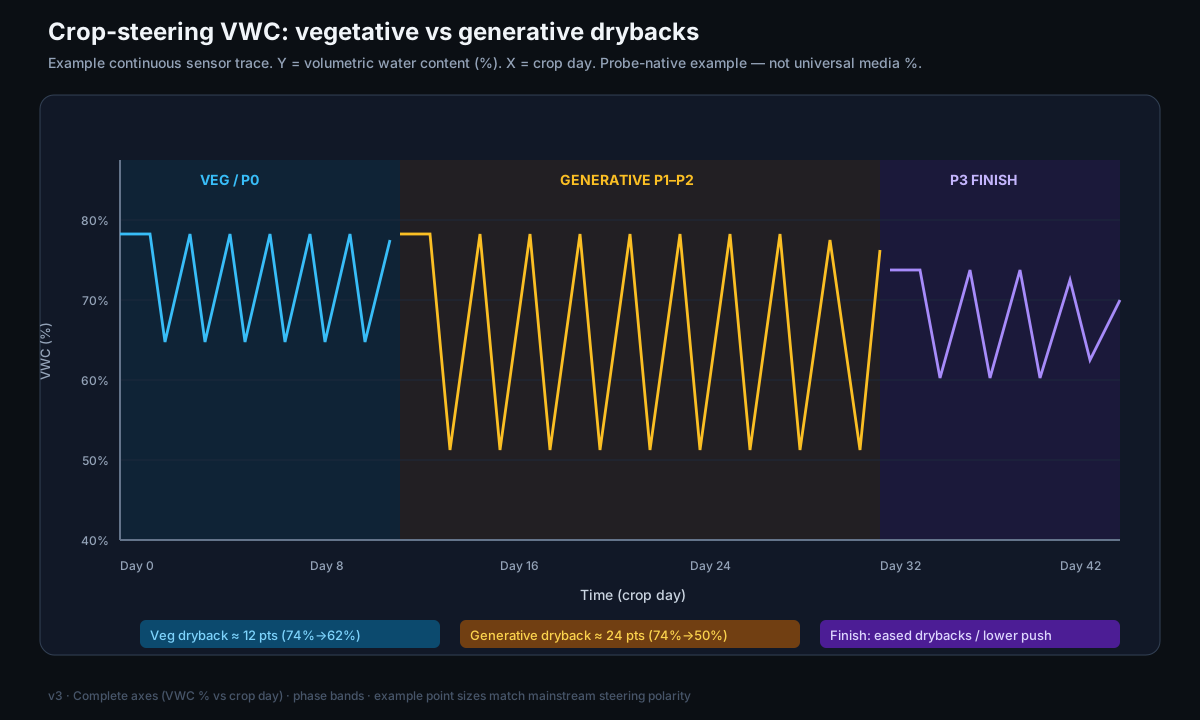
Crop steering is the practice of choosing exactly how wet and how salty to keep the root zone in order to shift which kind of growth the plant prioritises. In the wild, a plant reads a drought as a signal that time is short and pivots toward reproduction—this system delivers that signal deliberately, at a controlled dose and moment. Vegetative steering (bulking) keeps the medium wet with many small waterings and a small drying-out. Generative steering (the flower or stress push) uses a bigger drying-out, a saltier root zone, and fewer, larger waterings. Even a mild, deliberate water deficit applied at the right time shifts a cannabis plant generatively without losing yield.[1]
The system runs in two cooperating layers. A Home Assistant integration gives you every on-screen control and reading. An AppDaemon engine (master_crop_steering_app.py) is the decision-making brain that fires the shots. The room is wired as 3 rows (zones), each with its own moisture and salt probe and its own valve, all fed from one shared tank, one pump, and one main line.
- The ‘Phase (manual set)’ dropdown is an override. It shows what you last picked, not the live phase. Read
sensor.crop_steering_current_phasefor the truth. - Disarming is always safe by design.
switch.crop_steering_system_enabled = OFFmeans nothing can fire, ever.
Definitions
Three measurements run the whole system. Learn these first. Everything else builds on them.
Evidence and limitations
We've gone to great lengths to keep these guides honest. One of the main ways we do that is self-review: we actively look for claims that are subjective, only lightly backed by literature, or based on grower practice rather than a controlled study — and we call those out instead of dressing them up as settled science.
Often there simply is no paper for the decision you're making. In those cases we're drawing on what other growers report and what has worked in our own rooms. That can still be useful — but it is not a lab proof. Do what works for your plants, your room, and your meters. If a table disagrees with your crop, believe the crop and log the difference.
- Emergency stop ≠ disarm is a correct safety design principle
- Sensor-driven irrigation needs calibrated VWC, not raw factory %
- Phase machines and Home Assistant entity patterns for one facility class
- Default VWC numbers as universal substrate truth
- Caplan drought as full proof of a specific P0–P3 recipe
See something glaringly wrong? Tell us and we'll fix it. Please open a GitHub issue with the paper name and what looks off (include a source if you have one): Report an accuracy issue. Local law, labels, and licences always override any recipe here. Inline notes labelled grain of salt flag the highest-risk over-trust points in the text.
The P0–P3 daily cycle
Each row moves through four phases across the lights-on day, driven by the light schedule (defaults: lights on 10:00, off 22:00). The rhythm is always the same. Dry a little, refill, maintain, then wind down for the night.
- P0 (morning dryback): after lights-on the system waters nothing and lets the medium dry a small amount (
p0_dryback_drop_percent, e.g. 5–10%). Exits to P1 when that target is hit OR whenp0_maximum_wait_timeexpires (default 120 min). - P1 (ramp-up): shots start at
p1_initial_shot_size, grow byp1_shot_size_increment, are capped atp1_maximum_shot_size, spaced byp1_time_between_shots, and bounded by min/max shot counts. Exits when VWC ≥p1_target_vwc. - P2 (maintenance): the bulk of the day. Waters whenever VWC drops below
p2_vwc_threshold; if the EC ratio runs above ~1.2 it waters MORE (to dilute), below ~0.8 it holds back. - P3 (overnight): normal irrigation stops a set number of minutes before lights-off (
p3_veg_last_irrigation/_gen_); only emergency top-ups fire belowp3_emergency_vwc_threshold. Zones hold P3 all night.
The two steering modes pick which targets the engine chases. Vegetative means high VWC, modest dryback (~10–20%), lower EC (~3.0 mS/cm), many small shots. Generative means lower VWC, bigger dryback (~25–50%), higher EC (~4.5–6.0 mS/cm), fewer larger shots. Set the mode globally with select.crop_steering_steering_mode or per row. A row override beats the global, and ‘Follow Main’ means use the global.
| Mode | VWC target | Dryback | EC target | Shot pattern |
|---|---|---|---|---|
| Vegetative | High | Modest (10–20%) | ~3.0 mS/cm | Many small shots |
| Generative | Lower | Bigger (25–50%) | 4.5–6.0 mS/cm | Fewer, larger shots |
Irrigation controls and targets
Day to day you touch a handful of controls. Two arm switches set how ‘on’ the system is. System enabled is the master arm. OFF means nothing irrigates ever, and the engine fails safe to OFF if it cannot read the switch. Auto irrigation only governs engine-driven shots. Turning it OFF still lets manual shots through, which is how you run ‘watch mode.’
The targets that steer growth are the per-phase VWC numbers (p1_target_vwc, p2_vwc_threshold), the dryback targets, and the per-phase and per-mode EC targets (ec_target_veg_p0..p3 and ec_target_gen_p0..p3). Per-row selects let you push one row generative while the others stay veg, set who waters first when only one row can fire, and group zones to coordinate them.
- EC stacking switch ON lets the engine raise root-zone EC by reducing water, a generative push. Usually OFF for veg.
- Hardware you can see: the pump (Tuya plug, ~490 W running), the main-line relay, and
switch.f2_row1/2/3zone valves. Only one waters at a time. - Per-row selects: steering_mode, crop_profile (Follow Main + 7 profiles), group (A–D), and priority (Critical / High / Normal / Low).
- Shot duration is computed from
substrate_volume,dripper_flow_rate,drippers_per_plantand shot size %. Set these correctly or every shot is the wrong size. - Per-row safety caps:
max_daily_volume(L),shot_size_multiplier, andplant_count.
| System enabled | Auto irrigation | What happens |
|---|---|---|
| ON | ON | Normal: autonomous shots fire AND manual shots work |
| ON | OFF | Watch mode: armed but observe-only, manual shots only |
| OFF | either | Fully disarmed. Every shot blocked at the gate |
Run System enabled ON, Auto irrigation OFF while you confirm your numbers. The engine is armed and computing decisions but will not fire on its own. You can fire manual test shots and watch how the room responds before granting full autonomy.
Irrigation decision gates
When the engine decides a shot is needed, that shot only fires if it passes every safety gate in order. A single failed gate blocks it. This is what stops an autonomous system making a bad call.
- Order: system armed → auto-irrigation (manual bypasses) → zone enabled → no manual override → not dosing → tank not empty → source pH/EC in range (default pH 5.8–6.2) → safety limits (daily-volume cap, max-EC ceiling, max-frequency).
- pH/EC out of range blocks the shot and sends a phone alert with an ‘Irrigate Anyway’ button.
- Tank guard blocks only when the low float reads empty, so the system can keep watering as the tank drains down.
Source water that drifts out of the pH or EC window can lock out nutrients or burn roots. Gating on it, and alerting you rather than watering quietly, guards against feeding a bad solution to the whole room.
Calibration procedure
Calibration is the most important practical step. The system only behaves correctly if its number entities match your actual medium. The factory defaults are placeholders (50% VWC / 50% dryback), not your substrate. Dielectric moisture probes read differently in every medium, so a substrate-specific calibration is what makes the numbers mean anything.[2]
- 1ObserveHand-water normally for a few days and watch each row's VWC. The reading just after watering is roughly field capacity (the peak). The reading just before the next watering is the trough. Together they define that row's operating band.
- 2Set the bandSet
field_capacityjust above the highest peak,p1_target_vwcto each row's post-water peak, andp2_vwc_thresholda few percent below that. A smaller gap means a tighter veg band. - 3Set the drybacksVeg ~15–20%, gen ~25–45%.
p0_dryback_drop_percent5–15%. Set the emergency floor a few percent below the normal trough. - 4Set EC targetsSlightly above feed EC for veg, well above for generative.
p2_ec_high/low_thresholdare multipliers on target (1.2 dilutes above 120%, 0.8 conserves below 80%). - 5Run and refineLet it run a few cycles in watch mode, compare predicted against actual, and tighten the numbers.
Root growth itself changes how the probe reads over a run, so re-check the band occasionally rather than calibrating once and forgetting it.[4]
| Setting | Row 1 | Row 2 | Row 3 | What it does |
|---|---|---|---|---|
| p1_target_vwc | 26 | 22 | 18 | Peak VWC P1 refills to |
| p2_vwc_threshold | 22 | 19 | 15 | Water when VWC drops below this |
| vegetative_dryback_target | 18 | 18 | 18 | How far P0 dries (%) |
| p0_dryback_drop | 8 | 8 | 8 | Morning dryback amount (%) |
| emergency floor | 15 | 14 | 11 | P3 overnight top-up trigger |
| field_capacity (global) | 30 | 30 | 30 | Saturated peak / ‘full’ mark |
If you skip calibration and run the 50%/50% factory defaults, the steering is meaningless. The engine chases numbers that have nothing to do with your medium. Calibrate first, then arm.
Routine operating procedures
Most routine actions have a safe, prescribed method. Prefer the integration services over raw switch-flipping. The services run the full gated hardware sequence so you cannot skip a safety check by accident.
| Task | Safe method | Caution |
|---|---|---|
| Fire a manual shot | Service crop_steering.execute_irrigation_shot (zone, duration_seconds, shot_type: manual) | Runs the full gated sequence |
| Raw hardware (last resort) | Pump → main → valve ON; reverse to stop | One row at a time only |
| Force a phase | Change select.crop_steering_irrigation_phase | Immediate; bypasses normal transitions; selector then shows that phase |
| Irrigate Anyway override | Phone button after a pH/EC alert | 30-min bypass of the pH/EC gate ONLY; auto-clears when readings return in range |
| Disable vs pause a row | zone_N_enabled OFF (excluded) vs zone_N_manual_override ON (stays in steering) | Pause = hand-water while steered |
| Switch to generative | Select ‘Generative’ on steering mode (global or per-row) | Per-row beats global |
| Reset water counters | Automatic: daily at midnight, weekly Monday | Restart AppDaemon to re-init early |
It grants a 30-minute bypass of the pH/EC gate only. Every other interlock still applies: system armed, tank not empty, daily-volume cap. It auto-clears the moment pH/EC return in range.
Safety interlocks and troubleshooting
The system has layered fail-safes: the pH/EC source-water gate, a tank dry-run guard (blocks only when the low float reads empty), a blocked-dripper guard that parks a row for 2 hours after too many failed shots, fail-safe reads (an unconfirmed arm switch is treated as disabled), and persistent state saved every 5 minutes so zones come back in their saved phase after a restart.
There are two ways to force-stop and they differ in a way that matters. The dashboard EMERGENCY, ALL OFF button (script.f2_irrigation_all_off) kills the three hardware pieces fast but leaves the engine armed. It may re-energise on its next ~60 s phase-check. To truly disarm, flip System enabled OFF. For anything beyond a brief stop, use both.
| Trigger | What it touches | Engine state after |
|---|---|---|
| Dashboard EMERGENCY button | Kills pump, main, valves fast | Still ARMED, can re-fire next ~60 s check |
| System enabled OFF | Blocks every shot at the gate | Durably DISARMED |
| Engine auto emergency stop | Internal: parks the affected row | Armed, but offending row held |
- 1Fix the root causeSort the physical problem first: empty tank, kinked line, bad probe, blocked dripper.
- 2Confirm hardware offVerify pump, main line and all valves read off.
- 3Check engine arm stateLook at System enabled and Auto irrigation before re-arming.
- 4Re-arm and sanity-checkRe-arm, then read
sensor.crop_steering_current_phasefor the live phase. - 5Watch one cycleDo not walk away. Watch a full cycle fire correctly before trusting it again.
| Symptom | Likely cause | What to do |
|---|---|---|
| Zones stuck in one phase | Transition condition never met / bad target | Check the phase's exit threshold against live VWC |
| Valve open but no flow | Pump off, kinked line, blocked dripper | Check pump state and the line; clear the dripper |
| Status / Water-today reads unknown | Engine not running or sensors unpopulated | Restart AppDaemon; confirm probes report |
| Repeated pH/EC alerts | Source water genuinely out of range, or sensor drift | Test the solution; verify the pH/EC probe |
| Row repeatedly parked as blocked dripper | 4+ failed shots in 30 min | Clear the physical dripper; row auto-releases after 2 h |
| ‘Irrigation already in progress, skipping’ every cycle | Stuck flag after a mid-shot kill | Restart AppDaemon (ha addons restart a0d7b954_appdaemon). Phase + counters restore from disk |
The source flags that sensor.crop_steering_dryback_percentage and substrate EC reads can be suspiciously low (Row 1 at 0.48 mS/cm). Salinity strongly affects how dielectric probes report.[3] Check probe calibration before trusting EC steering.
Expected results and limitations
- Steering quality is bounded by calibration. The factory 50%/50% defaults are placeholders. Replace them with numbers from your own medium before you trust autonomous mode.
- Run watch mode first. Armed but observe-only, so you confirm thresholds and hand-test plumbing before granting full autonomy.
- Recommended numbers are starting points. Refine them over several cycles. Treating them as final is how rooms get over- or under-watered.
- Some sensors can mislead. Dryback-percentage may be unpopulated and EC can read suspiciously low. Verify probe calibration before trusting EC steering.
- Fail-safes guard hardware, but they trust the sensors. A bad probe or float can still cause a wrong decision well inside the ‘safe’ envelope.
Treat F2 like a precise tool, not an oracle. Tracking your numbers over time the way a process-control chart does lets you separate a real signal from ordinary variation before acting on it.[5] For the cultivation theory behind the dryback and EC levers, read the coco crop steering paper. To understand the probes the whole system trusts, read root-zone sensing next.
References
- Caplan, D., Dixon, M., & Zheng, Y. (2019). Increasing Inflorescence Dry Weight and Cannabinoid Content in Medical Cannabis Using Controlled Drought Stress. HortScience, 54(5), 964-969. https://doi.org/10.21273/HORTSCI13510-18
- Zawilski, B. M., Granouillac, F., Claverie, N., Lemaire, B., Brut, A., & Tallec, T. (2023). Calculation of soil water content using dielectric-permittivity-based sensors - benefits of soil-specific calibration. Geoscientific Instrumentation, Methods and Data Systems, 12, 45-56. https://doi.org/10.5194/gi-12-45-2023
- Qi, Q., Yang, H., Zhou, Q., Han, X., Jia, Z., Jiang, Y., Chen, Z., Hou, L., & Mei, S. (2024). Performance of Soil Moisture Sensors at Different Salinity Levels: Comparative Analysis and Calibration. Sensors, 24(19), 6323. https://doi.org/10.3390/s24196323
- Kang, S., van Iersel, M. W., & Kim, J. (2019). Plant root growth affects FDR soil moisture sensor calibration. Scientia Horticulturae, 252, 208-211. https://doi.org/10.1016/j.scienta.2019.03.052
- Mohammed MA. Statistical Process Control. Cambridge University Press (Elements of Improving Quality and Safety in Healthcare); 2024. https://doi.org/10.1017/9781009326834
Citations marked in-text as [n] map to this list. Primary literature and official guidance except where noted. Cannabis tissue culture is strongly genotype-dependent, verify dilutions, hormone doses and local regulations against the primary sources before relying on them.