Lighting: spectrum, PPFD and DLI
A from-zero guide to how grow light works: what the key numbers mean, what to aim for at each stage, and how to spot problems before they cost you a crop.
Purpose and scope
Light is the raw fuel a plant converts into sugar — the single biggest variable you control indoors. This paper starts from first principles: it defines every term, gives concrete targets for each stage, and explains the schedule change that makes a plant flower.
The plant captures energy from light and uses it to build sugar from CO2 in the air and water from the roots — like a solar panel that makes its own fuel instead of storing electricity. This process is photosynthesis, and it is why more usable light means more growth, up to the point where CO2, water or temperature becomes the limiting factor[8]. The three numbers that matter most are PPFD (how bright, right now), DLI (how much total light per day), and spectrum (the color mix). Every term is defined the first time it appears.
Read this one for the targets. Read the light acclimation paper for how to ramp up to them safely, so young plants adapt instead of bleaching.
Definitions
Get the gist of these five terms and the rest of the paper falls into place. They all describe the same thing from different angles: how much usable light a plant is getting.
Evidence and limitations
We've gone to great lengths to keep these guides honest. One of the main ways we do that is self-review: we actively look for claims that are subjective, only lightly backed by literature, or based on grower practice rather than a controlled study — and we call those out instead of dressing them up as settled science.
Often there simply is no paper for the decision you're making. In those cases we're drawing on what other growers report and what has worked in our own rooms. That can still be useful — but it is not a lab proof. Do what works for your plants, your room, and your meters. If a table disagrees with your crop, believe the crop and log the difference.
- PAR/PPFD/DLI definitions and photoperiod night-length control of flowering
- More light raises yield only until another factor limits (Liebig)
- LED efficacy bands for modern fixtures (era-dependent; check current DLC/maps)
- Stage PPFD tables for indoor cannabis without/with CO₂
- 9-point map uniformity checks
- Inverse-square as exact hang-height math for multi-bar LED panels (use maps + meters)
- Red light 'drives flowering' as the primary mechanism (photoperiod does; R:FR affects morphology)
- UV-B as a reliable potency booster (evidence mixed; safety cost real)
See something glaringly wrong? Tell us and we'll fix it. Please open a GitHub issue with the paper name and what looks off (include a source if you have one): Report an accuracy issue. Local law, labels, and licences always override any recipe here. Inline notes labelled grain of salt flag the highest-risk over-trust points in the text.
What each wavelength does to the plant
Blue light, roughly 400 to 500 nm, keeps plants compact with tight internode spacing and is linked to denser growth and resin in flower[3]. Red light, 600 to 700 nm, is the most photosynthetically efficient band and drives flowering and stretch[7].
‘Full-spectrum white’ LEDs are rated by color temperature in Kelvin. Higher-K and bluer (around 4000 to 6500K) leans veg, lower-K and redder (around 3000 to 3500K) leans flower. A good broad white spectrum works fine across both stages for beginners. The practical takeaway: do not over-optimize spectrum early. Intensity matters far more for yield than chasing a perfect color recipe.
| Band (nm) | Name | Main effect | When it matters |
|---|---|---|---|
| 280-400 | UV | Stress response, possible resin; safety hazard | Optional, end of flower |
| 400-500 | Blue | Compact growth, tight internodes, thicker leaves | Veg |
| 500-600 | Green | Penetrates deeper into the canopy than expected | Minor lever, all stages |
| 600-700 | Red | Highest photosynthetic efficiency; stretch is driven more by low blue and far-red, and flowering by photoperiod | Flower |
| 700-750 | Far-red | Speeds the dark response, adds stem stretch | Fine-tuning only |
A quality full-spectrum white LED covers veg and flower. Intensity beats spectrum tuning, so spend your attention on PPFD and DLI before you chase color recipes.
PPFD and DLI targets at each growth stage
Young tissue cannot process intense light, so targets climb as the plant matures. Clones and seedlings want about 100-250 PPFD (DLI roughly ~6-16 mol)[1], early-to-late veg about 300-600 PPFD (DLI ~20-35 mol), and flower about 700-900 PPFD without added CO2 (DLI ~30-45 mol)[2].
Pushing past about 900 PPFD only pays off if you also raise CO2 to 1000-1200 ppm and tighten temperature and humidity[8]. Otherwise extra light just causes stress and bleaching. Because DLI bundles intensity and hours together, you can hit the same daily dose with lower PPFD over more hours (veg at 18/6) or higher PPFD over fewer hours (flower at 12/12).
| Stage | PPFD (umol/m2/s) | DLI (mol/m2/day) | Photoperiod |
|---|---|---|---|
| Clone / seedling | 100-250 | ~6-16 | 18/6 |
| Early veg | 300-450 | ~20-29 | 18/6 |
| Late veg | 450-600 | ~29-39 | 18/6 |
| Flower (no CO2) | 700-900 | ~30-39 | 12/12 |
| Flower (CO2 1000-1200 ppm) | 1000-1400 | ~40-60 | 12/12 |
How day length triggers flowering
Photoperiod-type cannabis stays vegetative under long days (commonly 18/6) and is forced to flower by switching to 12 hours of light and 12 hours of uninterrupted dark[4]. This is ‘the flip.’
The plant tracks darkness, not light hours — think of it as a sand timer that runs only while the lights are off. If anything resets it mid-run, even a brief flash of light, it starts from zero. The mechanism is a pigment in the leaves called phytochrome, a light-sensitive molecule that shifts between two forms depending on light exposure; the balance between those forms tells the plant how long the night has been. When the dark period is long enough, phytochrome triggers the production of florigen — a mobile hormone that carries the signal from the leaves to the growing tips to start producing buds[5]. A light leak resets phytochrome mid-cycle: even a phone screen, an indicator LED, or a pinhole in a tent during lights-off can stall or revert flowering, cause re-vegging, or trigger hermaphrodites[4].
Light leaks during the dark period are the number one beginner flowering failure: stalled bloom, re-veg, or hermaphrodites. Far-red and red are exactly what phytochrome senses. Seal pinholes, cover indicator LEDs, use light-proof ducting. If you can see in the dark, so can the plant.
Choosing a fixture: LED, HPS or CMH
Modern LED is the efficiency leader at roughly 2.7-3.0 umol/J for good fixtures (budget units 2.0-2.3), runs cooler, and lasts longer[6]. HPS (high-pressure sodium) sits around 1.7-1.9 umol/J and runs hot but is cheap to buy. CMH/LEC (ceramic metal halide) lands lower, around 1.3-1.9 umol/J, but has a pleasant broad spectrum.
Efficacy (umol/J) is the number to compare. A 3.0 umol/J LED makes about 60% more usable light than a ~1.85 umol/J double-ended HPS for the same power bill[6]. For beginners, a reputable full-spectrum LED with a published PPFD map and efficacy at or above ~2.5 umol/J is the safe default. Ignore inflated ‘equivalent watt’ marketing and look at actual PPF (total umol/s) and coverage.
| Type | Efficacy (umol/J) | Heat | Upfront cost | Best for |
|---|---|---|---|---|
| LED | 2.0-3.0 | Low | Higher | Default choice, all stages |
| HPS | 1.7-1.9 | High | Low | Budget builds, red-heavy flower |
| CMH / LEC | 1.3-1.9 | Medium | Medium | Broad natural spectrum incl. some UV |
Setting height and intensity at each stage
Intensity falls with distance, but the inverse-square rule (a quarter of the light at twice the distance) is a point-source ideal that LED bars only approximate, so map PPFD with a meter rather than trusting the arithmetic. Height is your coarse intensity dial, the dimmer is the fine one. Hang about 60 cm (24 in) for seedlings and clones, ~45 cm (18 in) for veg, and ~30-40 cm (12-16 in) for flower, then fine-tune with the dimmer and a PAR meter.
Verify coverage by taking PPFD readings at nine points: four corners, four edge-midpoints, and the center. Aim for a min-to-average ratio above 0.75 so edge plants are not starved while the center bleaches. Hanging higher trades peak intensity for more even spread, so use a manufacturer PPFD map as your starting point and confirm with real readings at canopy height.
| Stage | Hang height | Target PPFD | Photoperiod |
|---|---|---|---|
| Clone / seedling | ~60 cm (24 in) | 100-300 | 18/6 |
| Veg | ~45 cm (18 in) | 300-600 | 18/6 |
| Flower | ~30-40 cm (12-16 in) | 700-900 | 12/12 |
Pair this with the light acclimation paper: raise the dimmer or lower the fixture over several days rather than jumping a fresh clone to full intensity.
Diagnosing common light problems
Too much light shows as bleaching (white or yellow bud tips directly under the fixture), upward-cupping or ‘taco’ leaves, and faded color even when nutrients are fine. The fix is to dim or raise the light, not to feed more.
Far-red (~730 nm) can speed the transition to dark via the phytochrome system and slightly stretch plants[4]. UV-B in the final 1-2 weeks is a popular potency play, but the evidence that UV-B reliably raises cannabinoids or yield is mixed[2], and it carries real eye, skin and plant-stress risks. Treat it as optional and advanced.
| Symptom | Likely cause | What to do |
|---|---|---|
| Bleached / white tops under the fixture | Too much PPFD | Raise or dim the light, do not feed |
| Taco / upward-cupping leaves | Light plus heat stress | Raise the light, check leaf-surface temp |
| Stretchy, pale growth | Too little light or hung too far | Lower the fixture or boost intensity |
| Stalled flowering, re-veg | Light leak during the dark period | Seal the room light-tight |
| Scorched tops, PPFD looks fine | Radiant heat (esp. HPS) | Raise the fixture, watch leaf temp |
Expected results and limitations
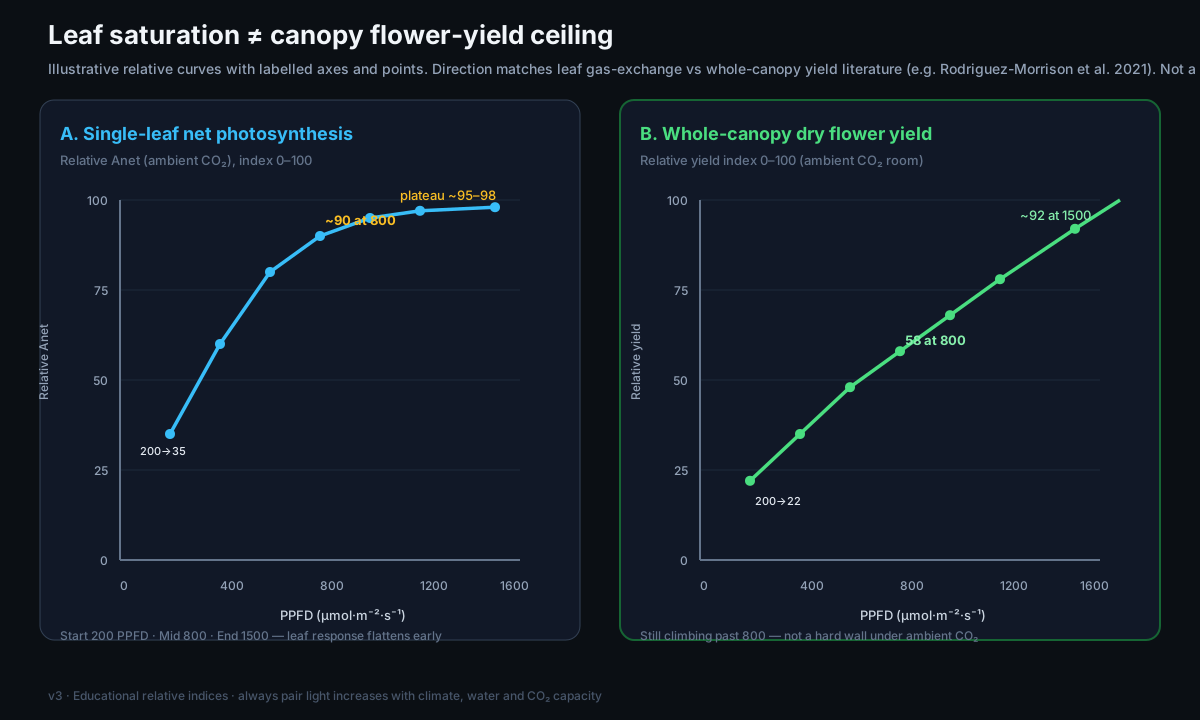
More light only helps up to the point where something else (CO2, water, nutrients, temperature or genetics) becomes the limiting factor. Past saturation you pay for electricity and heat with no extra yield, and eventually with stress[1].
- Without CO2, ~700-900 PPFD / ~35-45 mol DLI in flower is a sensible ceiling. The 1000-1400 PPFD regime needs CO2, cooling and humidity control: a whole-room commitment, not just a brighter light.
- Nail intensity, dose and photoperiod first. Spectrum tweaks like far-red and UV are fine-tuning, not the main lever.
- Buy on efficacy and a real PPFD map. Hit the stage targets, seal your dark period, and lighting stops being your bottleneck.
Once lighting is handled, the rest is climate, feed and genetics. Read the light acclimation paper for how to ramp safely, and the flowering stages paper for what happens after the flip.
References
- Rodriguez-Morrison, V., Llewellyn, D., & Zheng, Y. (2021). Cannabis Yield, Potency, and Leaf Photosynthesis Respond Differently to Increasing Light Levels in an Indoor Environment. Frontiers in Plant Science, 12, 646020. https://doi.org/10.3389/fpls.2021.646020
- Llewellyn, D., Golem, S., Foley, E., Dinka, S., Jones, A.M.P., & Zheng, Y. (2022). Indoor grown cannabis yield increased proportionally with light intensity, but ultraviolet radiation did not affect yield or cannabinoid content. Frontiers in Plant Science, 13, 974018. https://doi.org/10.3389/fpls.2022.974018
- Magagnini, G., Grassi, G., & Kotiranta, S. (2018). The Effect of Light Spectrum on the Morphology and Cannabinoid Content of Cannabis sativa L. Medical Cannabis and Cannabinoids, 1(1), 19-27. https://doi.org/10.1159/000489030
- Kusuma, P., Westmoreland, F.M., Zhen, S., & Bugbee, B. (2021). Photons from NIR LEDs can delay flowering in short-day soybean and Cannabis: Implications for phytochrome activity. PLOS ONE, 16(7), e0255232. https://doi.org/10.1371/journal.pone.0255232
- Eichhorn Bilodeau, S., Wu, B.-S., Rufyikiri, A.-S., MacPherson, S., & Lefsrud, M. (2019). An Update on Plant Photobiology and Implications for Cannabis Production. Frontiers in Plant Science, 10, 296. https://doi.org/10.3389/fpls.2019.00296
- Nelson, J.A., & Bugbee, B. (2014). Economic Analysis of Greenhouse Lighting: Light Emitting Diodes vs. High Intensity Discharge Fixtures. PLOS ONE, 9(6), e99010. https://doi.org/10.1371/journal.pone.0099010
- Westmoreland, F.M., Kusuma, P., & Bugbee, B. (2021). Cannabis lighting: Decreasing blue photon fraction increases yield but efficacy is more important for cost effective production of cannabinoids. PLOS ONE, 16(3), e0248988. https://doi.org/10.1371/journal.pone.0248988
- Chandra, S., Lata, H., Khan, I.A., & ElSohly, M.A. (2008). Photosynthetic response of Cannabis sativa L. to variations in photosynthetic photon flux densities, temperature and CO2 conditions. Physiology and Molecular Biology of Plants, 14(4), 299-306. https://doi.org/10.1007/s12298-008-0027-x
- Kotiranta, S., Pihlava, J.-M., Kotilainen, T., & Palonen, P. (2024). High light intensity improves yield of specialized metabolites in medicinal cannabis (Cannabis sativa L.), resulting from both higher inflorescence mass and concentrations of metabolites. Industrial Crops and Products, 211, 118210. https://doi.org/10.1016/j.indcrop.2024.118210
Citations marked in-text as [n] map to this list. Primary literature and official guidance except where noted. Cannabis tissue culture is strongly genotype-dependent, verify dilutions, hormone doses and local regulations against the primary sources before relying on them.