Crop steering in rockwool: water content, drybacks, and the recovery floor
Rockwool holds no nutrients of its own and has almost no buffer — what you feed is what the plant gets, within the same hour. That makes it the most precise substrate to steer and the fastest to show a mistake. This guide explains what a water-content percentage means in practice, how to calculate and read a dryback, the water level below which a block will not rewet from the dripper, and how to keep the slab in the right zone from clone to harvest without ever picking up a hose.
Purpose and scope
Rockwool (stone wool) is spun rock fibre. It holds no nutrients of its own and reacts with nothing you feed it, so root-zone EC is essentially the EC of the pore water (unused feed still leaves as runoff or concentrates on dryback)[1]. That makes it the most precise substrate you can steer with. It also means the block has no buffer: get the water wrong and the plant feels it the same hour.
This guide is only about the water and salt in the block, the part most growers run on feel. By the end you will know exactly what a water-content percentage is, how to calculate a dryback, the minimum you must feed, the point past which a dried-out block cannot be saved by the dripper, and how to hold the slab in the right zone for the whole grow using sensors and an irrigation controller, never a hose.
Saturate the block, then let it lose a controlled amount of water each day (the dryback). The size and timing of that dryback is your main steering lever. Feed enough each day to refresh the salts and get a little runoff, but never let the block fall below its recovery floor (around 25-30% water content), because below that it channels and will not rewet from a dripper[2].
Definitions
Evidence and limitations
We've gone to great lengths to keep these guides honest. One of the main ways we do that is self-review: we actively look for claims that are subjective, only lightly backed by literature, or based on grower practice rather than a controlled study — and we call those out instead of dressing them up as settled science.
Often there simply is no paper for the decision you're making. In those cases we're drawing on what other growers report and what has worked in our own rooms. That can still be useful — but it is not a lab proof. Do what works for your plants, your room, and your meters. If a table disagrees with your crop, believe the crop and log the difference.
- Rockwool holds almost no nutrient reserve; pore-water chemistry tracks feed closely
- Over-dry slabs can channel / rewet poorly
- Industry dryback bands and multi-shot irrigation schedules (Grodan-class practice)
- Runoff management to limit salt accumulation
- Exact recovery-floor WC % as a universal physics constant across all products
- Pure inverse-EC maths as exact substrate EC without plant uptake
See something glaringly wrong? Tell us and we'll fix it. Please open a GitHub issue with the paper name and what looks off (include a source if you have one): Report an accuracy issue. Local law, labels, and licences always override any recipe here. Inline notes labelled grain of salt flag the highest-risk over-trust points in the text.
Water distribution in rockwool
A rockwool block is mostly air. Around 95% of its volume is space between the fibres; the fibre itself is a tiny fraction[8]. Water clings to the fibres as a film and fills the smaller gaps, while the larger gaps stay full of air. Water content is simply how much of that space is water versus air at any moment.
Two consequences fall straight out of this. First, when water leaves the block the salt does not, so the EC of the water left behind climbs as the block dries. Second, because the medium buffers nothing, the EC and water content you set are the EC and water content the roots get, which is why rockwool can be steered so precisely and why mistakes show up so fast.
Interpreting water-content percentage
Everything in rockwool steering is a position on one vertical scale: how full the block is. Learn the band and where the danger is, and the rest is timing.
Grodan is explicit that medicinal cultivars are highly variable, so there is no single correct water content[1]. Treat every figure here as a starting point you confirm against your own slabs and sensor.
Note where the headroom is. The block can sit happily anywhere from field capacity down into the mid-40s. The cliff is only at the bottom. That asymmetry is the whole reason a controlled dryback is safe but an uncontrolled one is fatal.
Dryback calculation and management
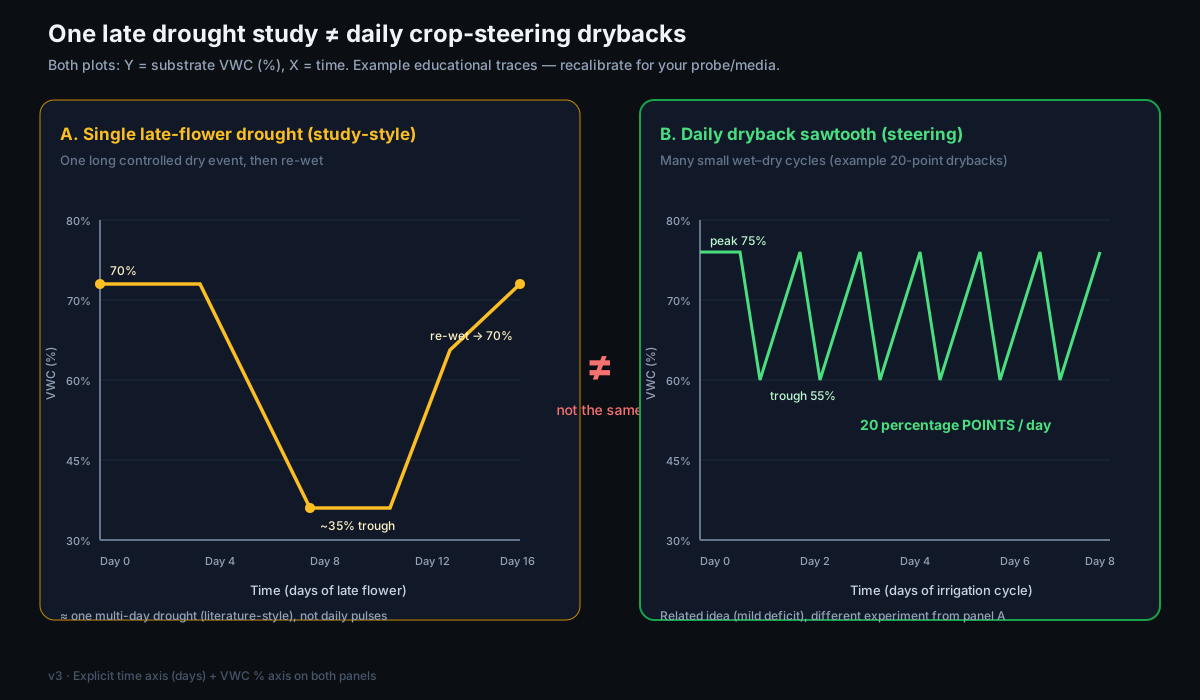
A dryback is the block losing water between its daily high and its next low. Think of a wet sponge left on the bench: it starts fully soaked, then air and the plant draw water out through the day. The amount it loses — from its soaked peak to its driest point before the next watering — is the dryback. The size of that swing and when you let it happen is the single biggest lever you have over how the plant grows.
Dryback in points = peak WC − trough WC. If the slab peaks at 78% and drops to 58% before the next irrigation, that is a 20-point dryback. As a fraction of the peak it is 20 ÷ 78 = 26%. Either way, your sensor gives you both numbers directly, read the high after the last shot and the low just before the next.
| Phase | Typical daily dryback | What it steers |
|---|---|---|
| Propagation / early veg | 5-10 points | Roots chase water, gentle |
| Late veg / bulk (wet) | 10-15 points | Maximum growth, vegetative |
| Generative flower push | 20-30 points | Stacks flower, slows stretch |
| Overnight (any phase) | add 5-15 points | Re-oxygenates the root zone |
As the block dries overnight, air refills the gaps and the roots and beneficial microbes get oxygen. Grodan's trials found that easing the standard night dryback by about 10% (a slightly wetter night) lifted yield in medicinal crops, because the root zone keeps working even while the canopy rests[1]. Some night dryback is essential; too much is not.
Block dry-out dynamics
A dryback is good up to a point and dangerous past it. The same process, water leaving the block, does four different things in sequence as it goes too far.
The middle stage is the one that catches people out. Because rockwool holds no salt of its own, the salt that was dissolved in the water stays put while the water disappears. Think of a pot of stock left to reduce on the stove: as the liquid goes down, the flavour concentrates. A block drying from 75% to 45% WC keeps only about three-fifths of its water (45 ÷ 75), so the salt left behind concentrates by the inverse, roughly two-thirds higher, because EC rises as 1 divided by the fraction of water remaining[3]. A 3.0 EC feed can climb past 5.0 EC in the root zone by late afternoon. That is why big drybacks must be paired with enough volume and runoff to keep the salt in check, covered below.
When you push a generative dryback, you are not only making the plant work for water, you are also concentrating its food. Watch substrate EC, not just water content. If EC climbs faster than you intend on the dryback, shrink the dryback or lower the feed EC.
Critical dry-out threshold
There is a water content below which a rockwool block will not rewet from the dripper no matter how long you run it. Nothing else here matters as much, because it is invisible until it has already happened.
Below roughly 25-30% WC the dry fibre stops wicking and preferential flow takes over[2][3]. The drip rate that kept a healthy block topped up cannot re-saturate a dry one, because the water never contacts the dry interior. Your runoff reads high and your sensor barely moves, the classic signature of a channeling block.
- Stop trusting the dripper to fix it. More drip just makes more runoff.
- Rehydrate by hand or by flooding: a long, slow, low-volume soak (or sitting the block in shallow feed) until the core takes water back, sometimes over hours.
- Then return to a normal schedule and find out why it dried out: a clogged dripper, a missed P1 ramp, a dead controller, or a dryback set too deep.
- A block that has been to the floor repeatedly develops permanent dry pockets and uneven wetting. Replace it rather than fight it.
Set a hard minimum water content in your controller and never let the trough cross it. The dryback is steering; the floor is a safety limit. They are not the same number and you should know both for every slab.
Minimum irrigation volume
Feeding rockwool is a balance of two jobs: put back the water the plant drank, and flush enough fresh feed through to stop salt stacking. Underfeed and EC climbs and the block trends toward the floor; overfeed and you drown the roots and lose your dryback.
- 1Size each shot to a few points of WCA single shot should lift water content by roughly 2-5 points. Big enough to register on the sensor, small enough not to blow straight to runoff.
- 2Reach field capacity in the P1 rampStack several shots after lights-on to climb from the overnight low back up to field capacity, then hold it.
- 3Get a small daily runoffAim for around 10-20% runoff once the block is at field capacity. That runoff is how you flush stacked salt and how you read substrate EC[1].
- 4Use runoff EC as the feedbackIf substrate or runoff EC is climbing day over day, you are not flushing enough, increase shot size or frequency. If EC is falling below target, cut runoff back.
- 5Never let the trough hit the floorWhatever the dryback, the pre-irrigation low must stay above the recovery floor with margin.
The minimum is whatever volume keeps the block above its recovery floor and substrate EC on target. In heavy flower under high light that can be a lot of small shots; in propagation it is very little. Let the sensor and the runoff EC set the number, not a fixed clock[5].
Vegetative and generative steering in rockwool
You steer the plant by choosing where the block sits in the band, how big the daily dryback is, and when you let it happen. Drier and bigger and earlier is generative; wetter and smaller and later is vegetative[7].
| Lever | Vegetative (leafy growth) | Generative (flower / fruit) |
|---|---|---|
| Daily peak WC | High, near field capacity | Lower, mid-band |
| Dryback size | Small, 5-15 points | Large, 20-30 points |
| First shot after lights-on | Early, short ramp | Delayed, longer overnight dryback |
| Substrate EC | Lower end of target | Higher, concentrated by the dryback |
| When to use | Early flower, bulking, recovery | Stretch control, flower set, ripening |
Grodan's trials found a consistently wetter daytime strategy produced higher yield with the same cannabinoid levels, especially across the first six of eight flowering weeks[1]. Steer generative with timing and dryback, but do not starve the plant of water and feed while it is still building the crop.
Maintaining rockwool saturation
The goal is to never touch a hose: the controller holds the block in the right zone from clone to chop, flushing salt with daily runoff so you never have to manually leach or top up a dry cube. The strategy is a planned arc of water content and dryback across the grow.
| Stage | Daily peak WC | Dryback | Substrate EC | Runoff |
|---|---|---|---|---|
| Clone / prop | High, gentle | 5-10 pts | Start higher than you'd think | Minimal |
| Veg | High | 10-15 pts | Step up | Low, 5-10% |
| Flower wk 1-3 | High (wet, bulking) | 10-18 pts | Step up again | 10-15% |
| Flower wk 4-6 | Mid | 20-30 pts | Highest | 15-20% to flush |
| Flower wk 7-8 | Mid, steady | 18-25 pts | Ease / as planned | Maintain |
A daily controlled runoff continuously replaces the salty water in the block with fresh feed, so EC never stacks to the point of needing a manual leach. And because the trough never crosses the recovery floor, no cube ever dries out enough to need a manual soak. The system holds the equilibrium for you, every day, if you set the limits correctly.
Sensor-based crop-steering systems
None of this works on a timer alone. Steering rockwool means measuring the block and letting the controller act on the measurement, closing the loop[5][6].
- Measure inside the block. A substrate sensor reads water content and EC where the roots are. Steer to substrate EC, not dripper or drain EC[1][4].
- Let the controller hold the curve. The irrigation controller runs the P1 ramp to field capacity, the P2 maintenance shots, and the P0/P3 dryback windows automatically, to water-content set-points rather than fixed times[5].
- Set the safety floor in software. A hard minimum water content the controller will always irrigate to defend, so the block can never reach the channeling point even if a dryback is set too deep.
- Watch the runoff EC daily. It is your early warning that salt is stacking or that you are over-flushing.
The companion papers cover the hardware and the daily cycle in depth: what the substrate sensor actually sees, how the watering brain decides, the P0-P3 cycle itself, and how to install and run the system.
Because rockwool buffers nothing, a closed-loop controller can steer it to a tighter tolerance than any buffered medium[1]. The inertness that makes it unforgiving is exactly what makes it the best substrate to automate.
Troubleshooting
| Symptom | Likely cause | Fix |
|---|---|---|
| Runoff high, sensor barely moves | Block channeling, core too dry | Hand-soak to rewet, then raise the floor and check drippers |
| Substrate EC climbing day over day | Not enough runoff, salt stacking | Bigger or more frequent shots to lift daily runoff |
| Substrate EC falling below target | Over-flushing, too much runoff | Cut shot size or frequency |
| WC won't reach field capacity | Shots too small, clogged dripper, or P1 too short | Check drippers, lengthen the P1 ramp[9] |
| Dryback far bigger than set | Plant drinking hard under high light, or a missed shot | Add P2 shots; verify controller and sensor |
| Slabs uneven across the room | Dripper flow or placement varies | Flush and check lines[9]; match dripper count to slab[10] |
Quick-reference targets
- Saturate to field capacity each morning with a P1 ramp.
- Hold it through the day with P2 maintenance shots and a small runoff.
- Let a planned dryback happen, sized to how generative you want to steer.
- Never let the trough cross the recovery floor.
- Steer to substrate EC and water content, read off the sensor, run by the controller.
References
- Grodan (ROCKWOOL Group). Grodan research reveals new insights into optimal irrigation strategy for large-scale production of medicinal crops. Whitepaper, with B. Nikaj; trials in partnership with Wageningen University & Research, 2020-2022. (industry/manufacturer or non-journal source) https://www.grodan.com/
- Owen, J., & Norden, D. (Profile Products). Understanding drainage in horticultural growing media. Greenhouse Management. (industry/manufacturer or non-journal source) https://www.greenhousemag.com/article/growing-media-defining-drainage-improve-substrate/
- International Society for Horticultural Science (ISHS). Utilizing the HYDRUS model as a tool for understanding soilless substrate water dynamics. Acta Horticulturae 1168. https://www.ishs.org/ishs-article/1168_41
- Moon T, Ahn TI, Son JE. Forecasting Root-Zone Electrical Conductivity of Nutrient Solutions in Closed-Loop Soilless Cultures via a Recurrent Neural Network Using Environmental and Cultivation Information. Frontiers in Plant Science. 2018;9:859. https://doi.org/10.3389/fpls.2018.00859
- Nemali, K. S. & van Iersel, M. W. (2006). An automated system for controlling drought stress and irrigation in potted plants. Scientia Horticulturae, 110(3), 292-297. https://doi.org/10.1016/j.scienta.2006.07.009
- Tavan, M., Wee, B., Brodie, G., Fuentes, S., Pang, A., & Gupta, D. (2021). Optimizing Sensor-Based Irrigation Management in a Soilless Vertical Farm for Growing Microgreens. Frontiers in Sustainable Food Systems, 4, 622720. https://doi.org/10.3389/fsufs.2020.622720
- Caplan D, Dixon M, Zheng Y (2019). Increasing inflorescence dry weight and cannabinoid content in medical cannabis using controlled drought stress. HortScience 54(5):964-969. https://doi.org/10.21273/HORTSCI13510-18
- Malik M, Tlustoš P (2025). Soilless growing media for cannabis cultivation. Agriculture 15(18):1955. https://www.mdpi.com/2077-0472/15/18/1955
- Netafim. Complete Irrigation Maintenance Guide (driplines, flushing, filtration and system upkeep). (industry/manufacturer or non-journal source) https://www.netafim.com/
- Athena Agriculture. Plant Spacing & Irrigation (metric), document A01.001 (pot, rockwool and pressure-compensating dripper selection). (industry/manufacturer or non-journal source) https://athenaag.com/
Citations marked in-text as [n] map to this list. Primary literature and official guidance except where noted. Cannabis tissue culture is strongly genotype-dependent, verify dilutions, hormone doses and local regulations against the primary sources before relying on them.